
Pricing has become one of the most data-intensive functions in retail and direct-to-consumer commerce. Competitors change prices daily, marketplaces increase price transparency, and internal stakeholders expect faster, more confident decisions across thousands of SKUs. In that environment, spreadsheets and static dashboards are no longer enough. This is why more retailers and brands are actively searching for AI pricing analytics software that can do more than visualize data. Modern AI pricing analytics software helps teams monitor price movements, understand competitor behavior, evaluate price position, and connect market changes to commercial decisions faster and with more context.
But the category is evolving quickly. What used to be a reporting layer is becoming a strategic intelligence layer. Instead of only showing charts, the newest platforms combine AI pricing analytics, pricing analytics, and conversational interfaces that help pricing teams understand what is happening and what to do next. In this guide, we explain what AI pricing analytics software actually does, how it has evolved from traditional pricing analysis to AI-powered pricing intelligence, and why conversational AI is changing how pricing teams work. We also show how the Omnia Agent turns pricing analytics from a dashboard exercise into a faster, more strategic workflow.
What Is AI Pricing Analytics Software?
AI pricing analytics software is software designed to help retailers and brands understand pricing performance, monitor the market, and support better pricing decisions using AI-driven analysis. It combines internal data and external market data to answer questions such as: Are we competitively priced? Where are we losing margin? Which products are overpriced? Which categories are becoming less competitive? And where do we have room to improve profitability without hurting sales? At its core, AI pricing analytics software transforms raw pricing data into insight. That includes competitor prices, market averages, price indices, match rates, assortment coverage, category trends, and pricing rule outcomes.
For many teams, AI pricing analytics becomes the operational foundation for pricing strategy because it connects data visibility with day-to-day decision-making. Historically, pricing analytics tools were mostly dashboard-driven. Analysts would log in, apply filters, compare time periods, and manually interpret patterns. That approach can still provide useful visibility, but it also creates friction. When insights depend on hours of dashboard work, pricing teams become slower than the market they are trying to follow.
Why AI Pricing Analytics Matters More Than Ever
Retail and ecommerce pricing have become far more dynamic over the last decade. Comparison shopping is now standard consumer behavior, and marketplaces like Amazon, Bol.com, eBay, and Google Shopping make prices easier to compare than ever before. For many categories, even a small price gap can affect visibility, conversion, or margin performance. As a result, pricing teams are under pressure from both directions. On one side, they need to protect competitiveness. On the other, they need to preserve margin and avoid reacting blindly to every competitor movement.
This is exactly where strong AI pricing analytics becomes critical. The goal is not simply to know what competitors are doing. The goal is to understand which market changes matter, how they affect your position, and what response fits your strategy. This is also why generic reporting is no longer enough. The best pricing analytics tools do not just collect information. They help teams identify structural overpricing, spot category-level risks, understand competitor strategy shifts, and connect pricing data to business impact.
Traditional Pricing Analytics Software vs AI Pricing Analytics Software
Traditional pricing analytics software was built for reporting. It typically gave users dashboards with competitor prices, filters, and trend graphs. Analysts could compare selected competitors, review price changes over time, and export data into spreadsheets. This represented a major improvement over fully manual pricing analysis, but it still left a large part of the work to the user. In practice, this meant pricing managers still needed to search for insights themselves. They had to decide which dashboards to open, which filters to use, which time period to compare, and how to interpret the results. The software showed the data, but the team still had to do the reasoning.
AI pricing analytics software changes that model. Instead of requiring pricing teams to manually hunt for insight, AI-powered systems can identify patterns, analyze pricing signals, and explain the results in plain language. This creates a fundamentally different workflow. Pricing teams move from data retrieval to decision support. The shift is similar to what happened in other analytics categories. Static reporting is being replaced by systems that are more dynamic, more contextual, and more responsive to user intent. In pricing, this evolution is especially powerful because the market changes so quickly. When teams can reduce analysis time, they can react with more confidence and less operational overhead.
Why Conversational AI Is Changing AI Pricing Analytics Software
One of the biggest developments in modern AI pricing analytics software is the rise of conversational AI. Traditional dashboards require the user to know where to click. Conversational AI allows the user to start with intent. Instead of navigating through filters and charts, pricing teams can ask direct questions and receive structured answers. This matters because the bottleneck in pricing is no longer access to data. Most teams already have more data than they can comfortably process. The bottleneck is interpretation.
Pricing managers need to understand competitive changes quickly enough to make decisions before the market moves again. Conversational AI solves this by reducing the manual work around analysis. It helps teams move from dashboard routines to direct insight workflows. The difference is not only convenience. It is also speed, focus, and scalability. A team that can ask pricing questions in natural language can evaluate more scenarios, investigate more anomalies, and make better use of the pricing data they already have.
How Omnia Agent Changes AI Pricing Analytics
Within Omnia, this conversational intelligence layer is powered by the Omnia Agent. The Omnia Agent is built directly into the platform and combines deep pricing knowledge with direct access to your pricing data and market data. Instead of manually exploring dashboards, pricing teams can ask a question, and the system runs the analysis, connects the dots, and explains what is happening, why it matters, and what to do next. This is a major step forward for AI pricing analytics software. Rather than acting as a passive reporting layer, the platform becomes an analytical collaborator.
Pricing managers can get answers in seconds that would previously require manual reporting, multiple exports, and cross-checking across different parts of the platform. Just as importantly, the Omnia Agent does this without turning pricing into a black box. Recommendations remain grounded in transparent logic, explainable outputs, and the pricing rules you define. That combination of visibility, automation, and explainability is what makes AI pricing analytics much more practical for real pricing teams.
What the Best AI Pricing Analytics Tools Should Include
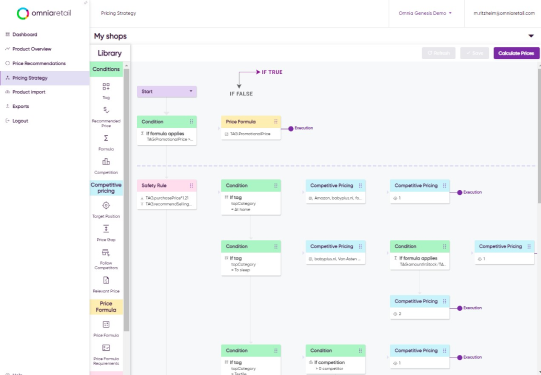
Not all pricing analytics tools offer the same value. The most effective platforms combine several capabilities that work together. First, they need strong market visibility: accurate competitor data, reliable matching, and clear benchmarking against the market. Second, they need analytical depth: the ability to move beyond raw prices and help users understand patterns, price gaps, trend changes, and category-level dynamics. Third, modern AI pricing analytics software should support action, not only observation. That means connecting insight to pricing strategy execution.
If a team discovers structural overpricing or margin opportunity, the system should help translate that insight into changes in pricing logic or rule configuration. Finally, the best platforms increasingly include conversational AI, because this is what reduces analysis friction and helps teams make better use of their data. That combination is especially powerful when pricing analytics is integrated with broader pricing workflows such as AI dynamic pricing and agentic pricing. At that point, AI pricing analytics is no longer a standalone reporting layer. It becomes part of an end-to-end pricing operating system.
AI Pricing Analytics Use Cases with Omnia Agent
The strongest way to understand modern AI pricing analytics is through practical use cases. The Omnia Agent shows how AI pricing analytics software can support real decisions, not just generate reports. Instead of asking teams to navigate dashboards, export reports, and manually interpret multiple data points, the Omnia Agent allows users to start with the question that matters and get both the analysis and the context immediately.
Use Case 1: Monitoring Match Rate Evolution Without Dashboard Work
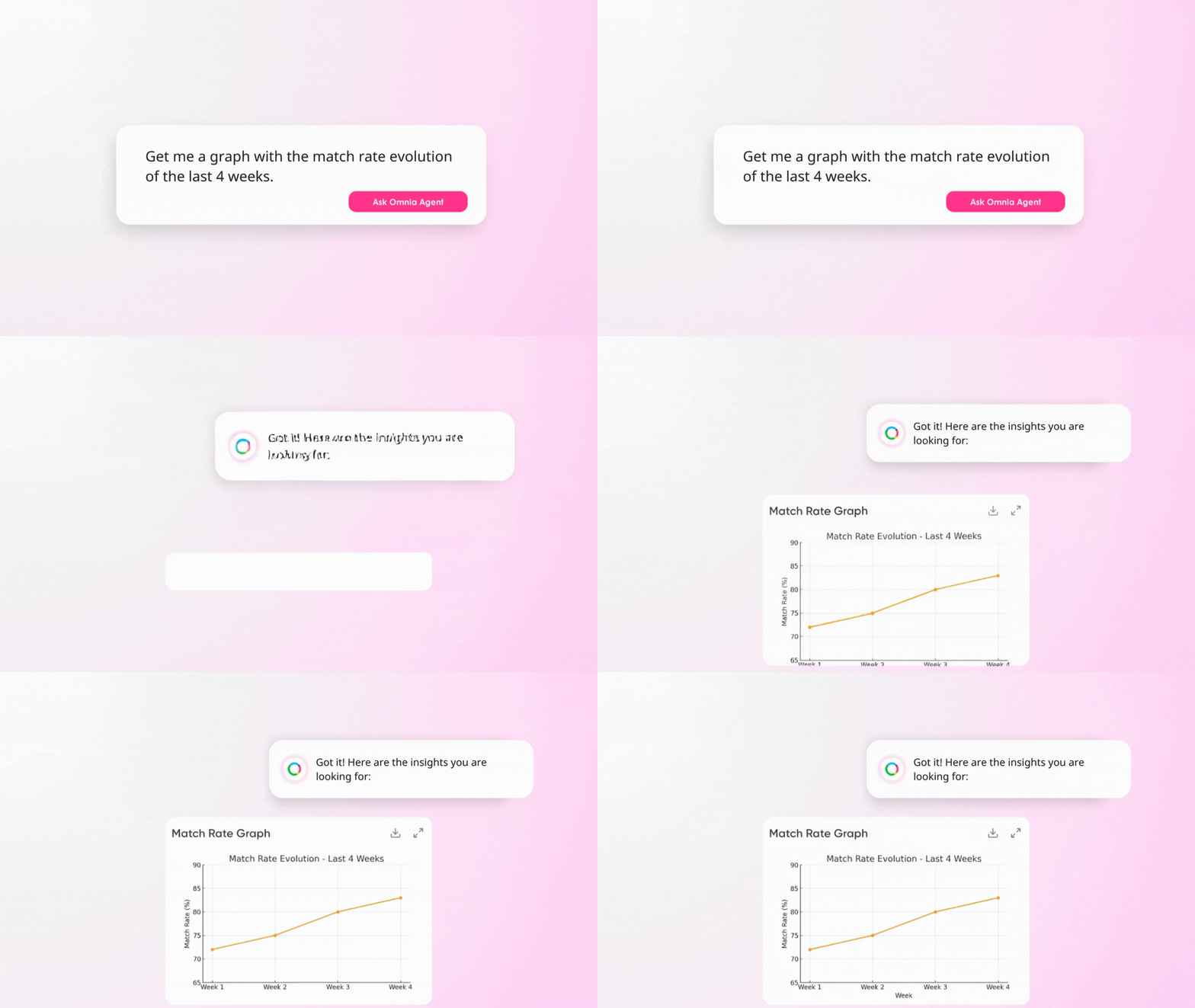
Match rate is one of the most important metrics in competitive pricing analytics. It shows how much of your assortment is directly comparable to competitor products. When match rate drops, it can indicate data issues, competitor assortment changes, or gaps in competitive coverage. Traditionally, understanding match rate evolution would require opening reporting modules, changing date ranges, and manually reviewing the output.
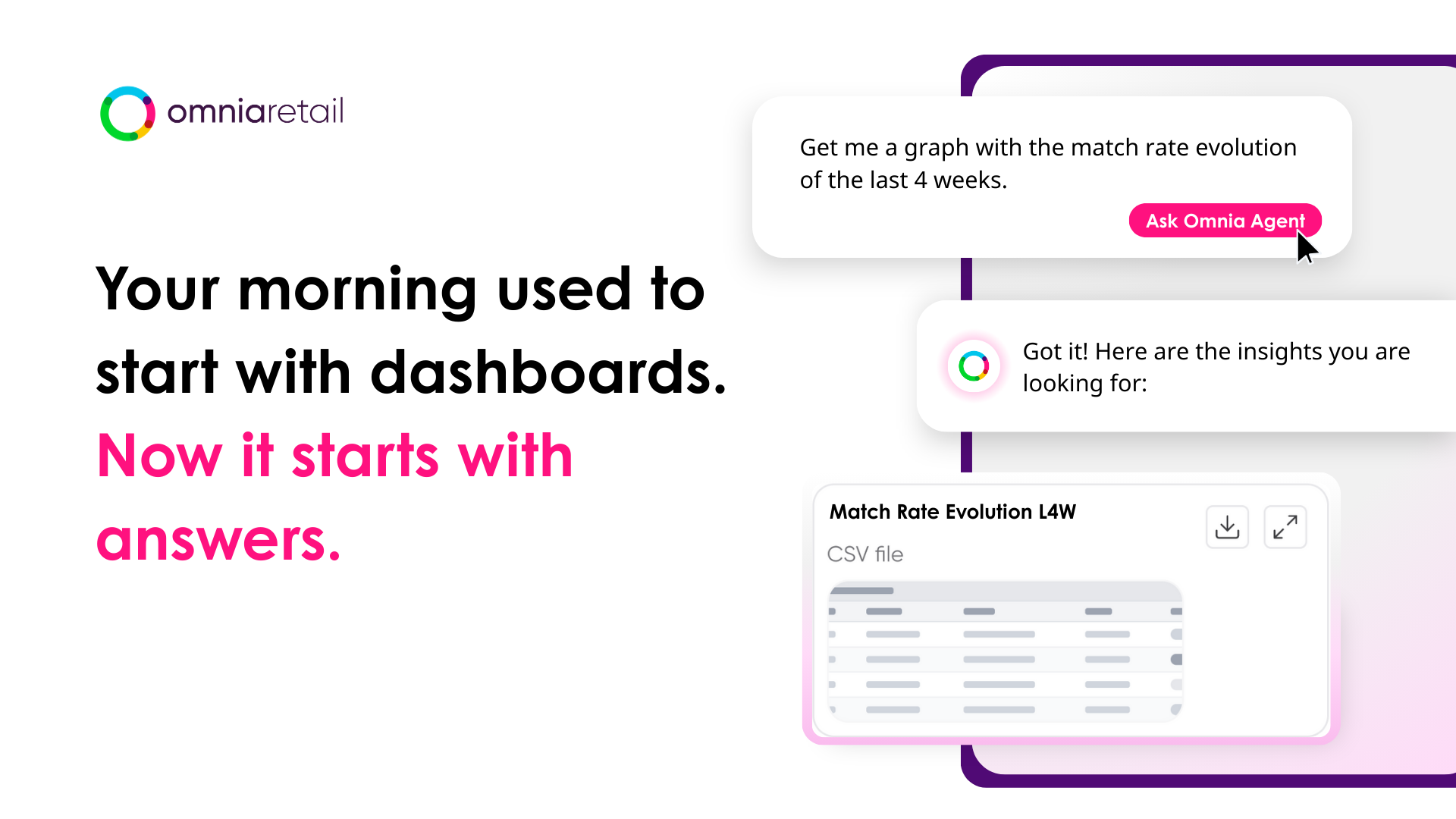
With the Omnia Agent, a pricing manager can simply ask: “Get me a graph of the match rate evolution of the last 4 weeks.” The system retrieves the historical data, generates the visualization, and explains whether the trend suggests a temporary anomaly or a broader structural change. This turns a multi-step analysis task into a direct AI pricing analytics workflow.
Use Case 2: Understanding Who Your Competitors Really Are
Many pricing teams think they know their competitors, but category-level reality is often more nuanced. The competitors that matter most may vary by assortment, brand, or channel. A modern AI pricing analytics tool should help teams understand their actual competitive landscape based on data, not assumptions. With the Omnia Agent, teams can ask: “Who are my competitors?”
The platform analyzes matching and market data to identify which retailers or marketplaces most frequently appear in relevant competitive comparisons. This helps teams validate who they should actually monitor and prioritize in pricing decisions.
.gif?width=1920&height=1080&name=Omnia%20Agent%20-%20Who%20are%20my%20competitors%20(1).gif)
Use Case 3: Finding Structural Overpricing Versus the Market Average
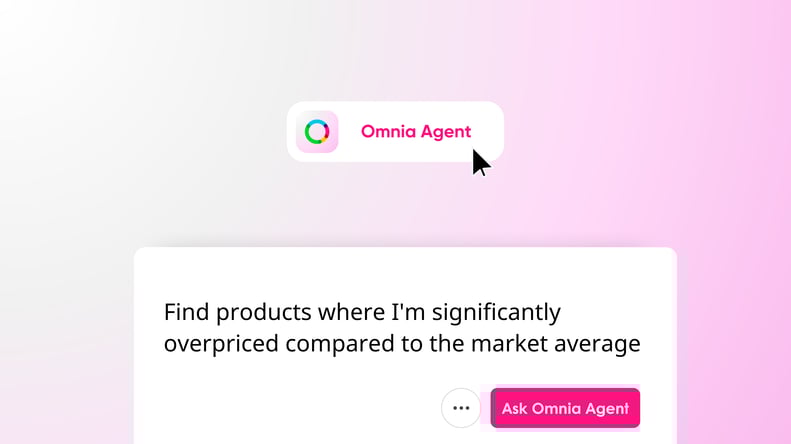
One of the most important analytical tasks in pricing is detecting where prices are systematically above market benchmarks. Small one-off gaps may not matter, but structural overpricing across a category or product set can quietly erode competitiveness and conversion performance. Instead of manually scanning product groups and price indices, a pricing manager can ask the Omnia Agent: “Find products where I’m significantly overpriced compared to the market average.”
The system evaluates price indices across matched competitor products and surfaces where pricing materially deviates from the benchmark. Crucially, it can also provide context: whether the issue is concentrated in a category, driven by a specific competitor, or linked to pricing rules that should be reviewed.
Use Case 4: Understanding What Changed in a Category
Retail markets change constantly. Promotions, stock issues, new competitors, and assortment changes can alter category dynamics within days. Pricing managers often need a fast answer to a simple question: what changed, and why should I care? With conversational AI, they can ask: “What changed this week in my category?”
Instead of comparing multiple reports manually, the system analyzes period-over-period market changes and returns a summarized explanation. This makes category-level AI pricing analytics faster and more practical, especially for teams managing large assortments or multiple regions.
Use Case 5: Identifying Margin Opportunity by Category
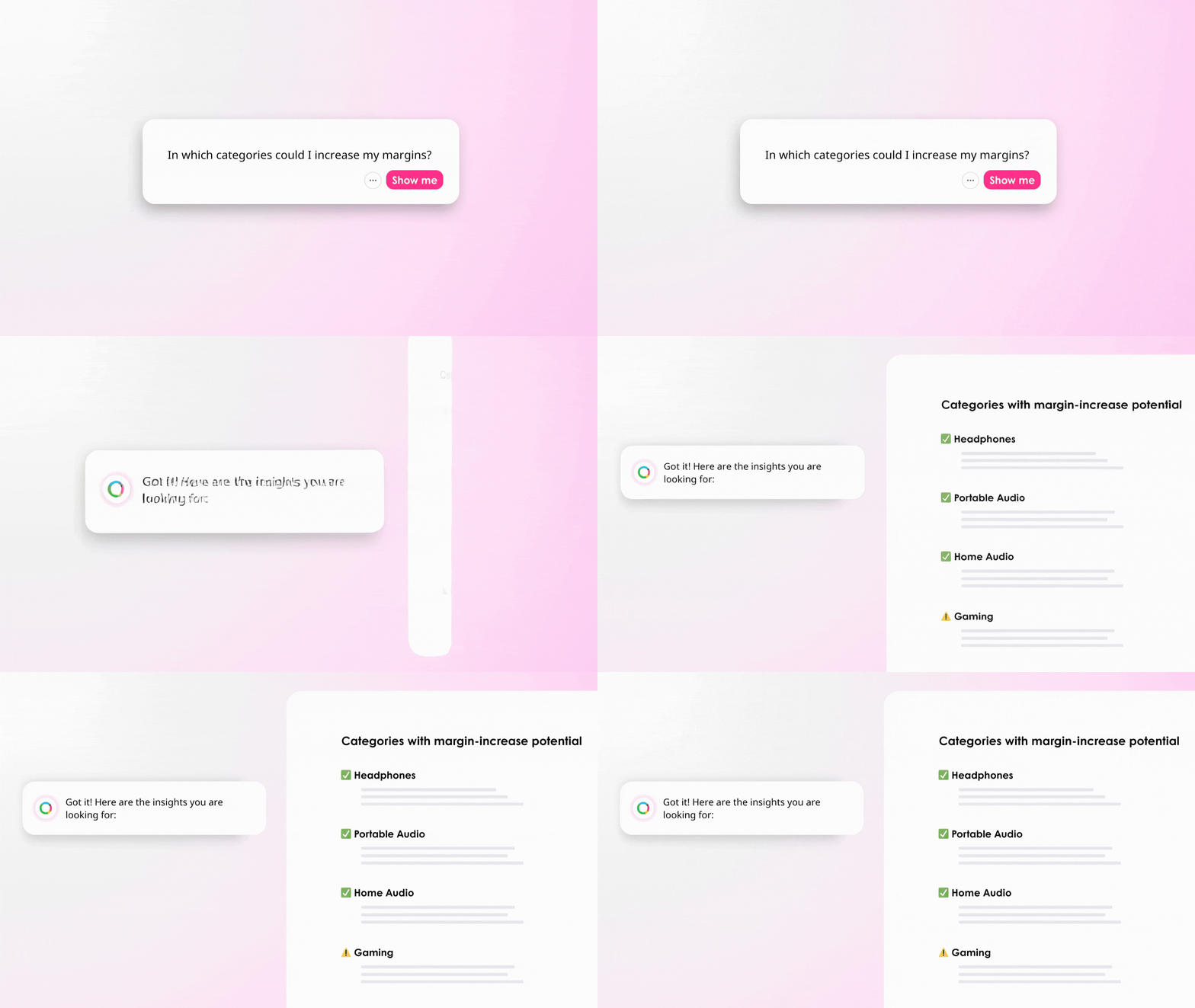
AI pricing analytics is not only about protecting competitiveness. It is also about finding where the business can improve margin intelligently. This requires more than just knowing competitor prices. It requires understanding where there is room to move without undermining price position. The Omnia Agent supports this by allowing teams to ask: “In which categories could I increase my margins?”
The system evaluates price position, competitor spread, and market dynamics to identify areas where margin expansion may be possible. This is a strong example of how AI pricing analytics supports more strategic pricing decisions, not just reactive ones.
How AI Pricing Analytics Software Connects to AI Dynamic Pricing
Strong AI pricing analytics becomes even more valuable when connected to pricing execution. On its own, analytics helps a team understand the market. When paired with AI dynamic pricing, it also helps the team act on that understanding more efficiently. This is the next step in the evolution from traditional pricing to AI pricing. Traditional pricing often relied on slow review cycles and manual updates. AI pricing uses rules, market signals, and automation to respond faster. AI pricing analytics software sits at the center of that shift, because it helps define where action is needed and why.
In other words, analytics and execution are increasingly connected. If the system identifies margin opportunity or structural overpricing, that insight should be able to inform pricing logic directly. This is why the future of pricing software is not a collection of separate tools. It is a more integrated system where monitoring, analytics, reasoning, and execution work together.
Why Conversational AI Will Replace Dashboard Rituals in AI Pricing Analytics
Many pricing teams still begin their day with dashboards. They review competitor moves, look at price position changes, and try to identify what matters. But this ritual is time-consuming, repetitive, and not always the best use of pricing expertise. The real value of a pricing team is not in clicking through charts. It is in making better commercial decisions. Conversational AI changes this dynamic. Instead of spending the first half hour of the day searching for signals, pricing teams can start with answers. They can ask what changed, where they are at risk, where the business has room to improve, and which competitors matter most right now.
This is a significant step forward for AI pricing analytics software. Dashboards will still have a role, especially for frequently reviewed metrics. But the most important shift is that the analytics layer no longer depends entirely on manual exploration. It becomes interactive, contextual, and far more aligned with how pricing teams actually think.
How to Choose the Right AI Pricing Analytics Software
If you are evaluating pricing analytics tools, there are several capabilities that should be considered essential. The platform should provide reliable competitor data and matching, clear market benchmarking, strong category and assortment-level visibility, and enough analytical depth to help teams move beyond surface-level reporting. Just as importantly, modern AI pricing analytics software should support explainability and action. Teams need to understand why the software surfaces certain insights and how those insights connect to pricing strategy.
This is one of the clearest advantages of AI-powered pricing analytics platforms with conversational interfaces: they reduce the effort needed to reach an answer while keeping the logic transparent. In practice, the strongest solutions increasingly combine four layers in one system: market data collection, pricing analytics, conversational AI, and pricing execution. That combination is where the most value is created, because it closes the gap between knowing and acting.
The Future of AI Pricing Analytics Software
The future of AI pricing analytics software is not defined by dashboards alone. It is defined by systems that can understand user intent, analyze pricing data in context, and explain outcomes clearly enough that teams can act with confidence. That is why the evolution from traditional pricing to AI pricing is also an evolution in analytics. AI pricing analytics is moving from reporting to reasoning. Pricing analytics is moving from visualization to explanation. And pricing analytics tools are becoming more conversational, more strategic, and more tightly connected to execution.
For retailers and brands, this matters because pricing complexity is not decreasing. If anything, it will continue to grow. Teams that still depend entirely on manual dashboards will increasingly struggle to keep up. Teams that adopt more intelligent, explainable, and conversational AI pricing analytics workflows will be able to think faster, act faster, and stay more aligned with their commercial goals.
The future of AI pricing analytics software is not just visual. It is conversational, intelligent, and agentic.