
It’s Monday morning, and you’re staring at three different dashboards trying to figure out why your match rate dropped 5% last week. Your competitor analysis spreadsheet has 47 tabs. The pricing team meeting starts in 20 minutes, and you still don’t have a clear answer about whether that new promotion strategy is actually working. Sound familiar?
This scenario plays out in pricing departments across retail every single day. While customer acquisition costs have tripled from $24-28 in 2015 to $78-82 in 2025, a staggering 233% increase, pricing managers are drowning in data but starving for insights. The solution isn’t more dashboards or faster spreadsheets. It’s a fundamental shift to agentic pricing.
What is Agentic Pricing for Retailers?
Agentic pricing represents a fundamental shift from rule-based automation to intelligent collaboration. Unlike traditional AI pricing models that simply execute predefined rules, agentic pricing systems act as analytical partners that understand context, recognize patterns, and provide strategic insights in natural language.
Think of it this way: traditional pricing software is like having a very fast calculator. Agentic pricing is like having a pricing analyst who never sleeps, processes thousands of data points simultaneously, and can explain their reasoning in plain English.
The market recognizes this transformation. The agentic AI market in retail and e-commerce is projected to grow from USD 60.43 billion in 2026 to USD 218.37 billion by 2031, reflecting a compound annual growth rate of 29.29%. This isn’t just about faster automation; it’s about fundamentally changing how pricing teams work.
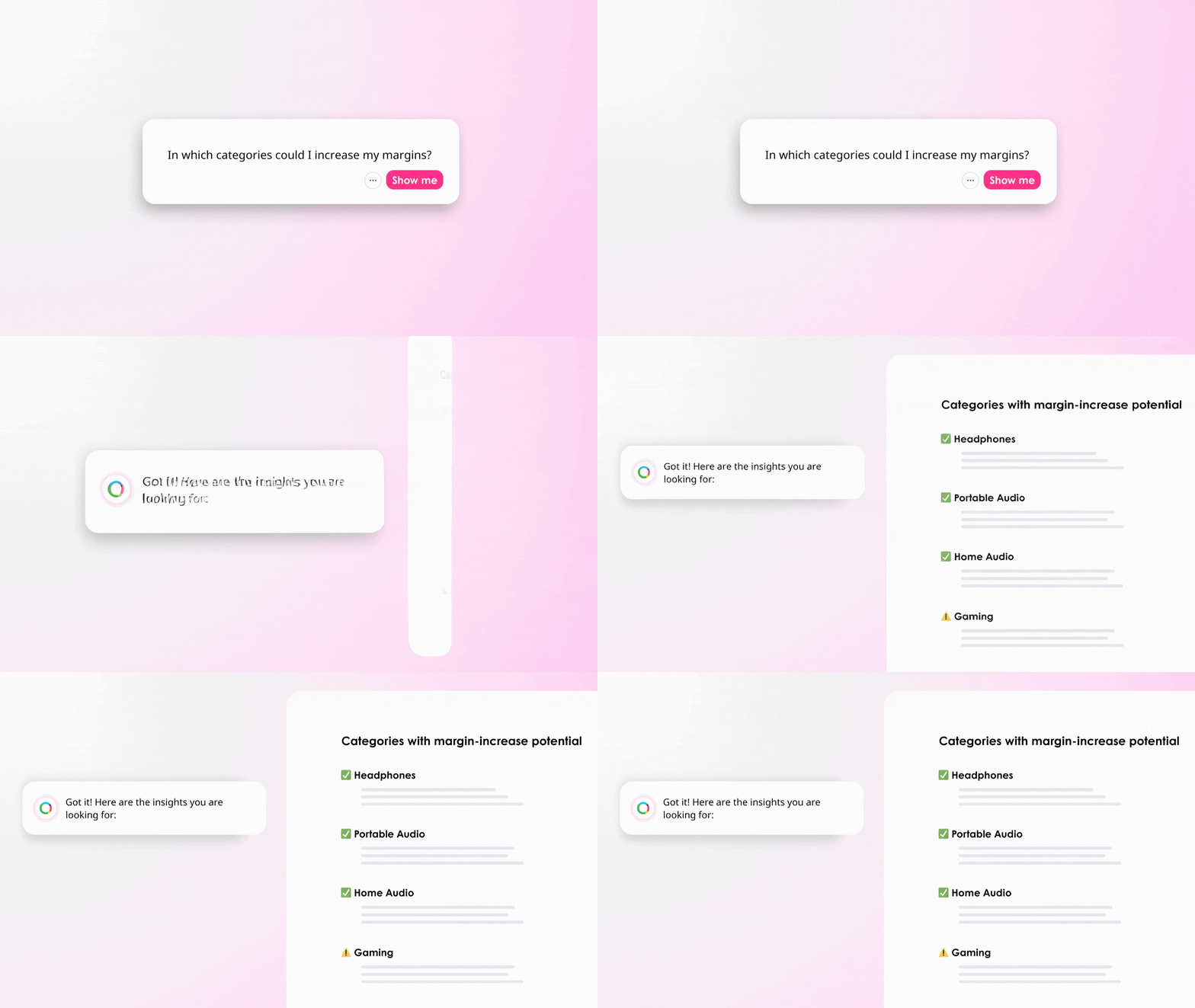
Here’s what makes agentic pricing different: instead of spending 30% of your week navigating dashboards to answer basic questions like “Why did our electronics category underperform last month?”, you can simply ask that question in natural language and get a comprehensive answer with supporting data, competitive context, and recommended actions.
How Agentic Pricing Works Behind the Scenes
The magic of agentic pricing lies in its ability to process multiple data streams simultaneously while maintaining transparency about its reasoning. Let’s break down what’s actually happening when you interact with an agentic pricing system.
Real-Time Market Intelligence
Your agentic pricing system continuously monitors competitor prices, inventory levels, and market trends across thousands of products. But unlike traditional price monitoring tools that simply collect data, agentic systems understand the context. They recognize when a competitor’s price drop is part of a clearance sale versus a strategic repositioning, and they factor this intelligence into their recommendations.
Pattern Recognition Across Data Dimensions
Traditional ai pricing software looks at individual data points in isolation. Agentic pricing systems recognize patterns across multiple dimensions simultaneously. They might notice that your match rate typically drops on Mondays in the electronics category, but only when a specific competitor runs weekend promotions, and only for products with certain margin profiles. This level of pattern recognition would take human analysts weeks to identify.
Natural Language Processing for Pricing Queries
Instead of clicking through multiple screens to generate a report on “match rate evolution over the last four weeks,” you can simply ask: “Show me how our match rates have changed this month and explain what’s driving the changes.” The system doesn’t just provide a graph; it explains the story behind the data, identifies the key factors, and suggests specific actions.
Transparent Decision-Making Process
Every recommendation comes with complete context and rationale. When the system suggests adjusting prices for a specific product category, it explains exactly why: competitor moves, demand patterns, inventory levels, margin implications, and expected outcomes. This transparency allows pricing managers to maintain strategic control while benefiting from AI-powered insights.
The result is what industry experts call “increased insight velocity”; the time between asking a business question and getting an actionable answer shrinks from hours or days to seconds.
The Five Game-Changing Benefits for Pricing Teams
Cognitive Load Reduction
Pricing managers report spending up to 30% of their time just finding and organizing data before they can begin analysis. Agentic pricing eliminates this data archaeology. When you need to understand why your sporting goods category is underperforming, you don’t need to export three CSV files, create pivot tables, and cross-reference competitor data. You ask the question, and the system provides a comprehensive analysis with supporting evidence.
Strategic Pattern Recognition
Human analysts excel at understanding business context, but they struggle to process the volume of data required for pattern recognition across thousands of SKUs. Agentic pricing systems identify structural overpricing compared to market averages, detect seasonal trends that might not be obvious, and spot competitive moves that could impact your positioning. All while you focus on strategic decision-making.
Faster Competitive Response
In retail, timing matters. When a major competitor adjusts their pricing strategy, every day of delayed response can impact market share. Agentic pricing systems detect competitive moves in real-time and immediately assess their potential impact on your business. Instead of discovering a competitor’s price change during your weekly review, you’re alerted within hours with a full analysis of implications and recommended responses.
Democratized Pricing Intelligence
Traditional pricing tools require specialized training and deep technical knowledge. Agentic pricing systems make sophisticated analysis accessible to your entire team through natural language interfaces. A category manager can ask complex questions about price elasticity or competitive positioning without needing to understand the underlying algorithms or data structures.
Maintained Human Control with AI Augmentation
The best agentic pricing systems don’t replace human judgment, they augment it. Every recommendation includes the reasoning, data sources, and confidence levels. Pricing managers can override suggestions, adjust parameters, and maintain strategic control while benefiting from AI-powered analysis and insights.
Real-World Applications: From Theory to Practice
Match Rate Monitoring and Optimization
Instead of manually tracking match rates across categories and trying to identify trends, agentic pricing systems provide continuous monitoring with intelligent alerts. When match rates drop, the system notifies you, it explains why, identifies which competitors are driving the change, and suggests specific actions to improve positioning.
Structural Overpricing Detection
Agentic pricing systems continuously compare your prices against market averages and identify products that may be structurally overpriced. But they go beyond simple price comparisons. They consider factors like brand positioning, product differentiation, and customer segments to provide nuanced recommendations about when higher prices are justified and when adjustments might improve performance.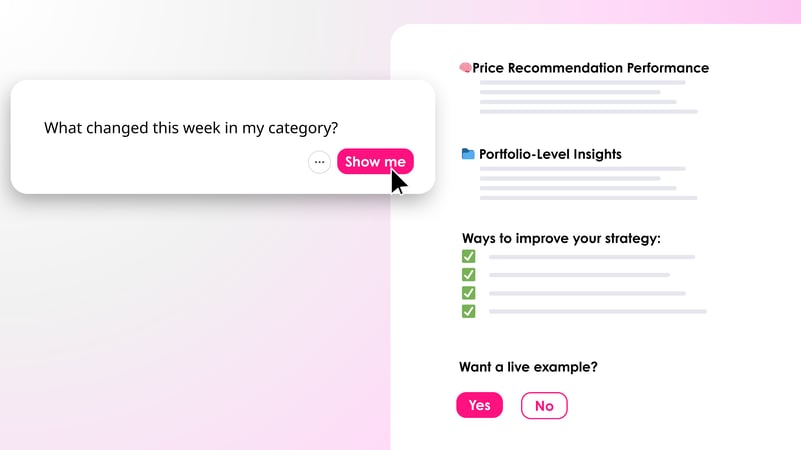
Promotional Strategy Analysis
When you run a promotion, agentic pricing systems track not just the immediate sales impact but also the competitive response, margin implications, and long-term effects on brand positioning. They can identify which promotional strategies generate sustainable lift versus those that simply shift demand between time periods.
Category-Level Strategic Insights
Agentic pricing systems excel at identifying category-level trends that might not be apparent when looking at individual products. They might recognize that your home goods category consistently underperforms during specific seasonal periods, not because of pricing issues, but because of inventory timing or competitive promotional calendars.
Implementation: Getting Started with Agentic Pricing
The transition to agentic pricing doesn’t require replacing your entire pricing infrastructure overnight. The most successful implementations start with pilot programs that demonstrate value before expanding across the organization.
Start with High-Impact Categories
Choose product categories where pricing decisions have a significant revenue impact and where competitive dynamics change frequently. Electronics, fashion, and seasonal goods often provide the best initial testing grounds because the benefits of faster, more intelligent pricing decisions are immediately apparent.
Focus on Team Adoption
The biggest challenge is the cultural aspect. Pricing teams need to shift from being data collectors to being strategic decision-makers. This requires training on how to ask the right questions, interpret AI-generated insights, and maintain strategic oversight while leveraging automated analysis.
Measure the Right Metrics
Success isn’t just about improved match rates or faster response times. The most important metrics are often qualitative: How much time does your team save on routine analysis? How quickly can you respond to competitive moves? How confident are your pricing decisions based on comprehensive data analysis?
According to Google Cloud’s analysis, retailers can reclaim up to 30% of their operating budgets currently consumed by administrative tasks by deploying AI agents to handle routine analysis and reporting. For pricing teams, this translates to more time for strategic thinking and less time spent on data manipulation.
The Future of Retail Pricing Intelligence
The evolution toward agentic pricing reflects broader trends in retail AI. Google Cloud identifies five key trends shaping the industry: agents for every employee, agents for every workflow, agents for customers, agents for security, and agents for scale. In pricing, this means every team member will have access to intelligent analysis, every pricing workflow will be augmented by AI, and the entire process will scale to handle increasing complexity without proportional increases in human resources.
Generative dialogue agents already captured 45.80% of the market share in 2025, indicating strong preference for AI systems that can engage in natural language processing, exactly the capability that makes agentic pricing so powerful for retail teams.
The retailers who embrace agentic pricing now will have a significant advantage as the market continues to evolve. They’ll have teams trained to work alongside AI, processes optimized for intelligent automation, and the infrastructure to scale their pricing operations without proportional increases in headcount.
Making the Strategic Shift
Agentic pricing isn’t just about better technology; it’s about transforming how pricing teams work. Instead of spending most of their time collecting and organizing data, pricing professionals can focus on strategic analysis, competitive positioning, and long-term planning.
The question isn’t whether agentic pricing will become standard in retail, the market growth projections and early adoption rates make that clear. The question is whether your organization will be among the early adopters who gain competitive advantage, or among the followers who struggle to catch up.
For pricing managers facing increasing complexity, rising customer acquisition costs, and growing competitive pressure, agentic pricing offers a path forward that combines the best of human strategic thinking with AI-powered analysis and insights. The technology is available today, the market is growing rapidly, and the competitive advantages are clear.
The future of retail pricing is agentic. The question is: when will you make the shift?
Interested in seeing how AI Dynamic Pricing works in practice? Book a demo.