Disclosure: this article is published by Omnia Retail, which is ranked #1 below. The ranking reflects our own editorial judgment based on publicly available vendor information, not an independent audit — weigh that accordingly, as you should with any vendor-published "best of" list.
AI pricing analytics software helps retailers and brands set and adjust prices using real-time market data, demand signals, and machine learning, instead of static spreadsheets and manual price reviews. For teams comparing the best AI pricing analytics software, the differences that matter most aren't which platform "has AI" — nearly all of them do — but how much implementation burden your team can absorb, how transparent the pricing logic is, and how much of the day-to-day analysis the platform does for you instead of leaving it to a dashboard.
This overview compares four widely discussed platforms: Omnia Retail, Revionics, Pricefx, and BlackCurve. The comparison focuses on the criteria that actually affect buyer outcomes: ease of implementation, depth of competitive monitoring, pricing rule flexibility, and how much human oversight the platform leaves you with.
What Should the Best AI Pricing Analytics Software Actually Do?
Every platform in this category uses machine learning somewhere. That alone tells you very little. The real question is whether the AI is transparent enough for a pricing team to audit and defend a price change internally, and increasingly, whether it does the analytical work itself instead of leaving a manager to interpret a dashboard.
The best AI pricing software combines real-time competitor and market monitoring with pricing logic your team can actually read, override, and explain, plus a realistic path from signed contract to a system that's live and trusted. A newer capability is separating the leaders from the rest here too: agentic, conversational AI that lets a pricing manager simply ask a question and get an answer, a chart, or a report back, rather than building one manually.
Omnia Retail stands out in this comparison because it combines that transparency and real-time monitoring with a conversational AI layer, Omnia Agent, that pricing managers can question directly. Revionics, Pricefx, and BlackCurve each solve a different version of the same problem, from enterprise demand science to fast ecommerce deployment, but they ask for a different amount of implementation effort in return, and none centers a conversational assistant the way Omnia does.
How the Best AI Pricing Analytics Software Compares
The table below captures the primary differentiator for each platform and the key tradeoff to weigh before requesting a demo.
| Software | Category | Typical Implementation | AI Approach | Best For |
|---|---|---|---|---|
| 1. Omnia Retail | Dynamic pricing + price intelligence | Weeks; rule engine editable by non-technical staff | Conversational agentic AI (Omnia Agent) that builds reports and dashboards from a chat prompt, on top of real-time competitor monitoring | Retailers and brands wanting a conversational AI assistant on top of pricing automation, without a data science team |
| 2. Revionics | Enterprise price optimization | Several months; deep integration with pricing, inventory, and sales data | Demand-based science and predictive analytics across full assortments | Large retailers and CPG brands with dedicated pricing teams and complex margin structures |
| 3. Pricefx | Enterprise pricing platform (PO&M + CPQ) | Weeks to months, faster than legacy enterprise suites but scales with configuration scope | AI-powered optimization plus a fully modular, logic-agnostic rule engine | Global B2B companies with multi-currency, multi-region pricing complexity |
| 4. BlackCurve | Ecommerce pricing automation | Days to a few weeks; pre-built ecommerce integrations | Rule-based automation with built-in competitor and market data feeds | Mid-market ecommerce brands wanting fast deployment without custom scrapers |
How we built this table: platforms are grouped by primary buyer profile, not independently scored. Capability claims reflect publicly documented features and vendor materials; confirm current scope and pricing directly with each vendor before committing.
A Closer Look at the Best AI Pricing Analytics Software
1. Omnia Retail: Conversational AI for Pricing Teams

Best for retailers and brands that want a conversational AI assistant on top of pricing automation, without requiring a data science team.
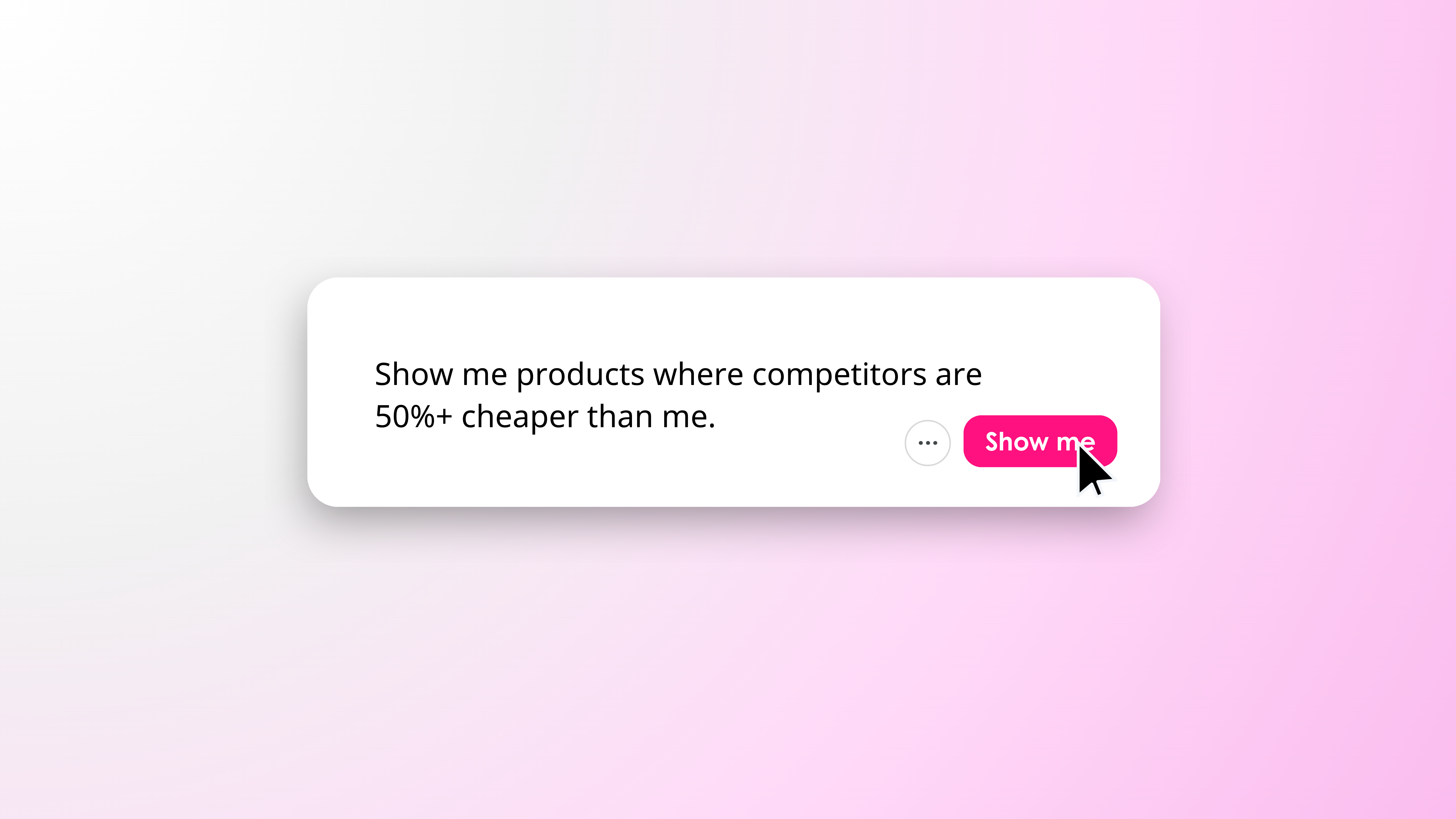
Standout feature: Omnia Agent lets pricing managers ask direct questions in natural language, such as "who are my competitors?", "what changed this week in my category?", or "in which categories could I increase my margins?", and get back a structured report, chart, or dashboard built on the fly, instead of navigating to one themselves.
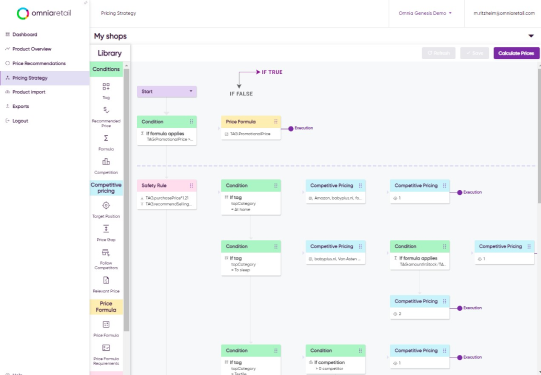
Omnia Retail adjusts prices based on competitive activity, inventory levels, and demand signals, and pairs that automation with a conversational AI layer built directly into the platform. Rather than exporting spreadsheets or filtering dashboards to find an insight, pricing managers can ask Omnia Agent for a match-rate graph, a list of overpriced products, or a summary of what moved in a category this week, and receive the answer with an explanation attached. Implementation typically takes a few weeks, and both the underlying pricing rules and the AI layer sitting on top of them are things a pricing manager can use directly, without waiting on platform support or a BI team to build a report.
- Pros:
- Conversational AI (Omnia Agent) built directly into the platform, able to generate reports, charts, and dashboards from a chat prompt instead of requiring manual dashboard navigation.
- Transparent, rule-based pricing logic underneath the AI layer, so managers can still audit and adjust the reasoning behind a price.
- Real-time competitor monitoring built in, useful for categories where market prices shift daily, and directly queryable through the agent.
- Cons:
- Agentic workflows are most valuable once basic pricing rules and data quality are in place; teams starting from scratch will spend initial setup time on that foundation first.
- Pricing is quote-based rather than published.
2. Revionics: Enterprise-Grade Demand Science
Best for large retailers and CPG brands managing thousands of SKUs across multiple channels, with the budget and team to support a multi-month rollout.
Standout feature: Demand-based science models price elasticity, promotions, and markdowns together across full assortments, rather than pricing each lever in isolation.
Revionics (now part of Aptos) uses machine-learning models to forecast product demand under different price, promotion, and external conditions, feeding that into price and markdown recommendations across a retailer's full lifecycle. It's built for enterprises managing complex assortments and promotional calendars, not for teams that need to be live in a few weeks. The vendor has also begun adding conversational analytics and an early multi-agent system, though this sits alongside its core demand-science engine rather than being the platform's central interface the way Omnia Agent is for Omnia Retail.
- Pros:
- Deep demand forecasting that connects pricing, promotions, and markdowns in one model.
- Recognized as a full-lifecycle price optimization leader for retail specifically.
- Recently added conversational analytics and an early multi-agent system for pricing workflows.
- Cons:
- Implementation typically runs several months, since the system requires deep integration with pricing, inventory, and sales data.
- Best suited to enterprises with dedicated pricing teams; the setup complexity delays time-to-value for smaller organizations.
3. Pricefx: Maximum Flexibility for Global B2B Operations
Best for global B2B companies with multi-currency, multi-region pricing complexity and the resources to manage a configuration-heavy rollout.
Standout feature: A logic-agnostic, modular architecture lets you build custom pricing and CPQ workflows without writing code, then run them at scale across dozens of markets and currencies.
Pricefx combines price management, Configure-Price-Quote (CPQ), AI-powered optimization, and pricing analytics on one cloud-native platform. It integrates with any ERP or CRM rather than requiring a specific one, and its AI layer, including a recently launched conversational Copilot, sits on top of a rule engine you define yourself. That flexibility is real, but it comes with a cost: several reviewers describe the platform as a "blank canvas" that needs a skilled implementation partner to get full value from.
- Pros:
- Deep configurability for complex, multi-currency, multi-region B2B pricing.
- Combines price management, CPQ, and analytics in one modular platform rather than separate tools.
- Cloud-native with a growing AI toolkit (Pricefx Agents, Copilot) aimed at reducing implementation time.
- Cons:
- Configurability is a double-edged sword: it typically requires a skilled implementation partner and carries a real risk of cost overruns.
- Best suited to organizations whose pricing complexity is genuinely global, not simpler catalogs.
4. BlackCurve: Fast Deployment for Ecommerce Brands
Best for mid-market ecommerce brands that need AI-driven pricing without a months-long implementation cycle.
Standout feature: Out-of-the-box integrations with platforms like Magento, BigCommerce, Amazon, and eBay mean setup can start immediately, without building custom scrapers or data pipelines first.
BlackCurve targets ecommerce businesses that want to automate and optimize pricing at scale without a long rollout. Pricing rules are template-based, which speeds up deployment but trades away some of the customization available in Pricefx or Revionics. It's built for teams that need to stay competitive on price in a fast-moving market and don't have the infrastructure for deep custom integrations.
- Pros:
- Fast setup with pre-built integrations across major ecommerce platforms and marketplaces.
- Built-in competitor and market data feeds, removing the need for custom scraping.
- API access available for teams that do want deeper integration later.
- Cons:
- Template-based rules limit customization compared to Pricefx or Revionics for complex margin structures.
- Less suited to multi-channel pricing logic that goes beyond ecommerce.
Common Ways Buyers Get AI Pricing Software Selection Wrong
- Judging platforms by "does it have AI" instead of what the AI actually does. All four platforms here use machine learning, but only one centers a conversational assistant a pricing manager can question directly. Decide first whether your team wants to ask questions in natural language or work through a rules engine, since that changes which platform fits.
- Underestimating implementation friction. Most organizations overestimate their customization requirements and underestimate how long integration takes. Revionics and Pricefx can both take months if your data and systems aren't ready; confirm a realistic timeline before signing, not after.
- Choosing enterprise-grade demand science for a straightforward catalog. If your product categories don't have complex interdependent margin rules, a transparent platform like Omnia Retail or BlackCurve will get you to value faster than an enterprise suite built for thousands of SKUs and multi-month rollouts.
- Assuming a data science team is required (or isn't). Omnia Retail and BlackCurve are designed for non-technical pricing teams. Revionics and Pricefx benefit from data science or implementation-partner support during setup, even if pricing analysts can operate them afterward. Know which one your team actually is before you buy.
- Treating vendor ROI benchmarks as guarantees. Margin improvement figures cited in industry reviews vary widely by category and competitive intensity. Treat them as directional, and ask each vendor for their refresh frequency and coverage for your specific category before committing.
Best AI Pricing Analytics Software: Final Verdict
Start with Omnia Retail if you want a working pricing system in weeks, with logic your team can read and adjust, plus a conversational AI assistant that can build a report or chart the moment you ask for one. Move to Revionics if enterprise scale and demand-based margin science are your competitive edge and you have the team to support a multi-month rollout. Choose Pricefx when global complexity or custom B2B pricing and CPQ workflows are non-negotiable. Pick BlackCurve if speed matters more than deep customization and your ecommerce pricing logic is relatively standard.
The real differentiator across all four platforms is not the AI itself, since each uses machine learning in some form. It's how much setup burden you can absorb, how much customization you genuinely need, and, increasingly, how much of the analytical work the platform will do for you the moment you ask. Start with the simplest platform that solves your immediate problem, then expand from there.
FAQs: Best AI Pricing Analytics Software
1) How long does it take to see ROI from an AI pricing analytics platform?
Most retailers see measurable impact within the first 30–60 days of active use, assuming the team follows platform recommendations consistently. Platforms with faster setup, such as Omnia Retail or BlackCurve, tend to show results sooner. Complex implementations like Revionics or Pricefx may take several months to fully optimize. Margin improvement ranges cited in industry reviews vary widely by category and competitive intensity, so treat vendor benchmarks as directional rather than guaranteed.
2) Do I need a data science team to use these platforms?
No, not for all of them. Omnia Retail and BlackCurve are designed for non-technical pricing teams and require minimal data science involvement. Revionics and Pricefx benefit from data science or implementation-partner support during setup but can typically be operated by pricing analysts once configured. The real question is not whether you need data science, but whether you have the internal bandwidth to manage a longer integration project.
3) Can these tools monitor competitor prices in real time?
Yes, all four platforms include competitor monitoring, but the mechanism differs. Omnia Retail includes real-time competitor price monitoring built into the core platform, queryable directly through Omnia Agent. BlackCurve includes pre-built data feeds for major ecommerce platforms and marketplaces. Revionics folds competitive price tracking into its broader demand-science model. Pricefx integrates with your existing data sources rather than running its own scraping layer. Ask each vendor for their refresh frequency and category coverage before committing.
4) What is the typical cost range for AI pricing software?
All four platforms are custom-quoted based on SKU volume, data complexity, and feature set, so published pricing is rare in this category. Cost correlates more with implementation scope and data volume than with AI sophistication. Request itemized quotes that separate platform licensing from implementation and support fees, especially for Revionics or Pricefx, where implementation cost can rival or exceed the first year of licensing.
5) What's the real difference between these platforms if they all use AI?
Not how much AI each platform has, but what it's applied to and how transparent it is. Omnia Retail applies AI to a conversational assistant, Omnia Agent, that generates reports, charts, and dashboards on request, on top of transparent, real-time pricing rules. Revionics applies it to demand forecasting across pricing, promotions, and markdowns together. Pricefx applies it inside a fully configurable, logic-agnostic rule engine. BlackCurve applies it to template-based automation with built-in data feeds. The right choice depends on whether your team wants a conversational interface, deep customization, or speed most.
6) Is enterprise-grade demand science (Revionics, Pricefx) overkill for a mid-market retailer?
Often, yes. Both platforms are built for organizations with dedicated pricing teams, complex margin structures, and the budget to support a multi-month rollout. Mid-market retailers with more straightforward catalogs typically get to value faster with a platform like Omnia Retail, which pairs that speed with a conversational assistant for day-to-day questions, or BlackCurve, and can revisit enterprise-grade demand science later if complexity grows.
7) Which of these platforms lets a pricing manager just ask a question instead of building a report?
Omnia Retail is the only platform in this comparison built specifically around that workflow: Omnia Agent answers natural-language questions like "who are my competitors?" or "show me products where I'm significantly overpriced" with a structured report or chart, generated on the spot. Revionics and Pricefx have both introduced early conversational or agentic features, but as additions to a broader analytics or rules engine rather than the platform's central interface. BlackCurve does not offer a comparable conversational layer.