Consumer electronics heads into the 2026 holiday season with an awkward combination. Devices cost more to build because AI data centres are soaking up memory chips, yet shoppers still hold out for a deal. In the Netherlands, electronics is the one category a meaningful group of people delays until Black Friday. Add a comparison landscape that is changing under Google, Amazon and AI assistants, and the margin for pricing mistakes is thin.
Key Findings
- Devices cost more this year. AI data centres are snapping up memory chips, so device makers pay far more for them. Gartner expects memory prices to more than double by the end of 2026, pushing PCs up 17% and smartphones up 13% compared with 2025.
- Electronics is what people wait for. In our podcast with Philips, we discussed how shoppers in different categories, e.g., fashion vs. electronics, behave when it comes to anticipation and patience around discounts. A TV or laptop is a big, planned purchase, so people hold out for a deal. In a survey by comparison site Overstappen.nl, 14% of Dutch consumers said they wait until the end of November to buy one, more than for any other category.
- Electronics discounts start earliest. In Omnia's data from Germany and the Netherlands, electronics prices started sliding in early November 2025, weeks before Black Friday. Sporting goods and beauty held firm until the final stretch. We think retailers move early because electronics is the category shoppers plan their deals around.
- Cheap doesn't mean discounted. In most categories, products under €50 get cut most often. Electronics spreads its discounts across every price range, from accessories to devices over €300, because brands tend to put something from every category on offer, says Philips' D2C pricing lead.
- US discounts hold steady. Pricier parts haven't made US retailers stingier, at least on paper. Adobe expects online electronics discounts to peak at 30% off list again this season, the same as last year, with the best deals on Cyber Monday.
- Germany is the weak spot. Shoppers are holding on to their money there. MediaMarkt owner Ceconomy grew in its Black Season quarter thanks to markets like Spain and Italy, while the rest of the DACH region was marked by consumer restraint. In the UK, Currys grew like-for-like revenue 6% over the summer.
----
Europe up close: the Netherlands, Germany and the UK
European electronics shoppers are deal-hunting and buying early, but the growth is uneven: Southern and Western Europe are carrying the big chains, while Germany stays cautious.
Netherlands
Electronics is what the Dutch save for Black Friday. A TV or laptop is a big purchase, so people wait for the deal. 14% hold off until late November, against 9% for household appliances and under 5% for clothing, a survey by comparison site Overstappen.nl found. Younger shoppers wait the most: among 18 to 34-year-olds, it's 40%.
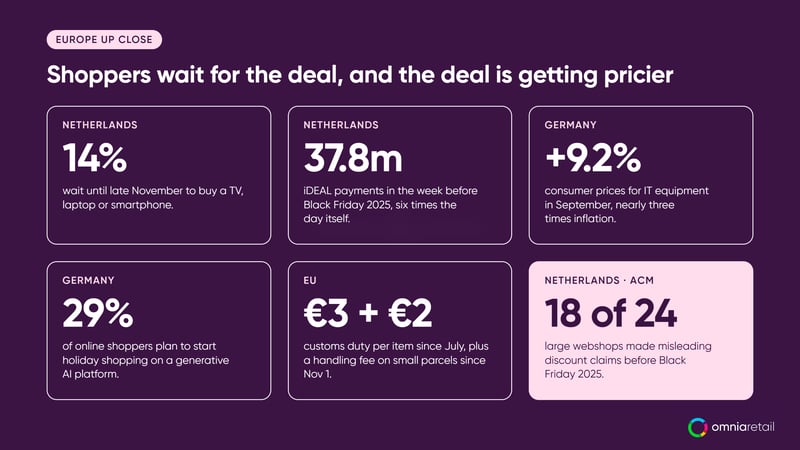
The run-up week still beats the day itself. Dutch shoppers made 37.8m iDEAL payments in the seven days before Black Friday 2025, about six times the 6.25m on the day, and up from 28.6m in 2023.
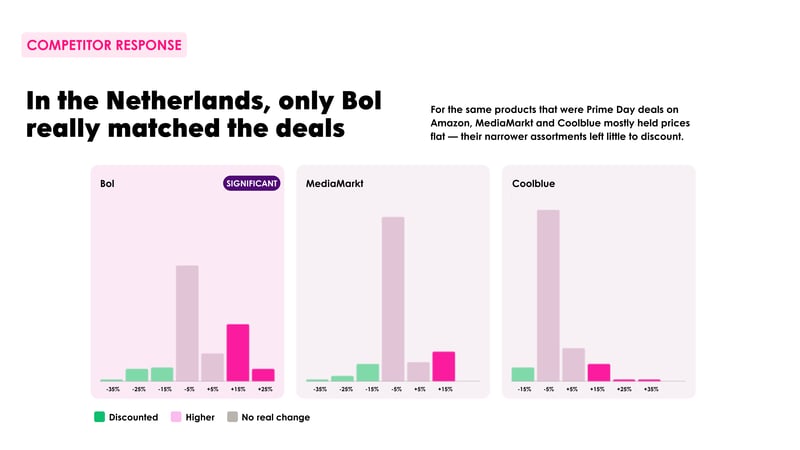
Only bol.com matched Amazon. When Amazon cut prices on Prime Day, bol.com cut with it. MediaMarkt and Coolblue mostly sat it out, our Prime Day analysis found.
Cheap imports just got pricier. Chinese webshops took almost a third of Dutch cross-border purchases last year, according to Thuiswinkel. The EU is now going after that flood of small parcels, 5.9bn of them in 2025 and over 90% from China. Since July, it has charged €3 customs duty per item on online orders under €150 from outside the EU, and a €2 handling fee on small parcels kicked in on Nov 1. For cables, chargers and earbuds, the cheap rival you've been matching may not be so cheap anymore.
The regulator is watching strike-through prices. Before last Black Friday, the Dutch ACM checked 24 big webshops, including electronics sellers, and found misleading discount claims at 18 of them, mostly around the 'from' price.
Germany
Germany is bracing for a flat Christmas. Retail association HDE expects November and December sales to grow 2%, or about 1% once you take out inflation, and more than half of non-food retailers expect a worse season than last year, Reuters reported. HDE's Black Friday forecast usually lands mid-November. Last year it predicted the first drop since it started counting in 2016, to €5.8bn.
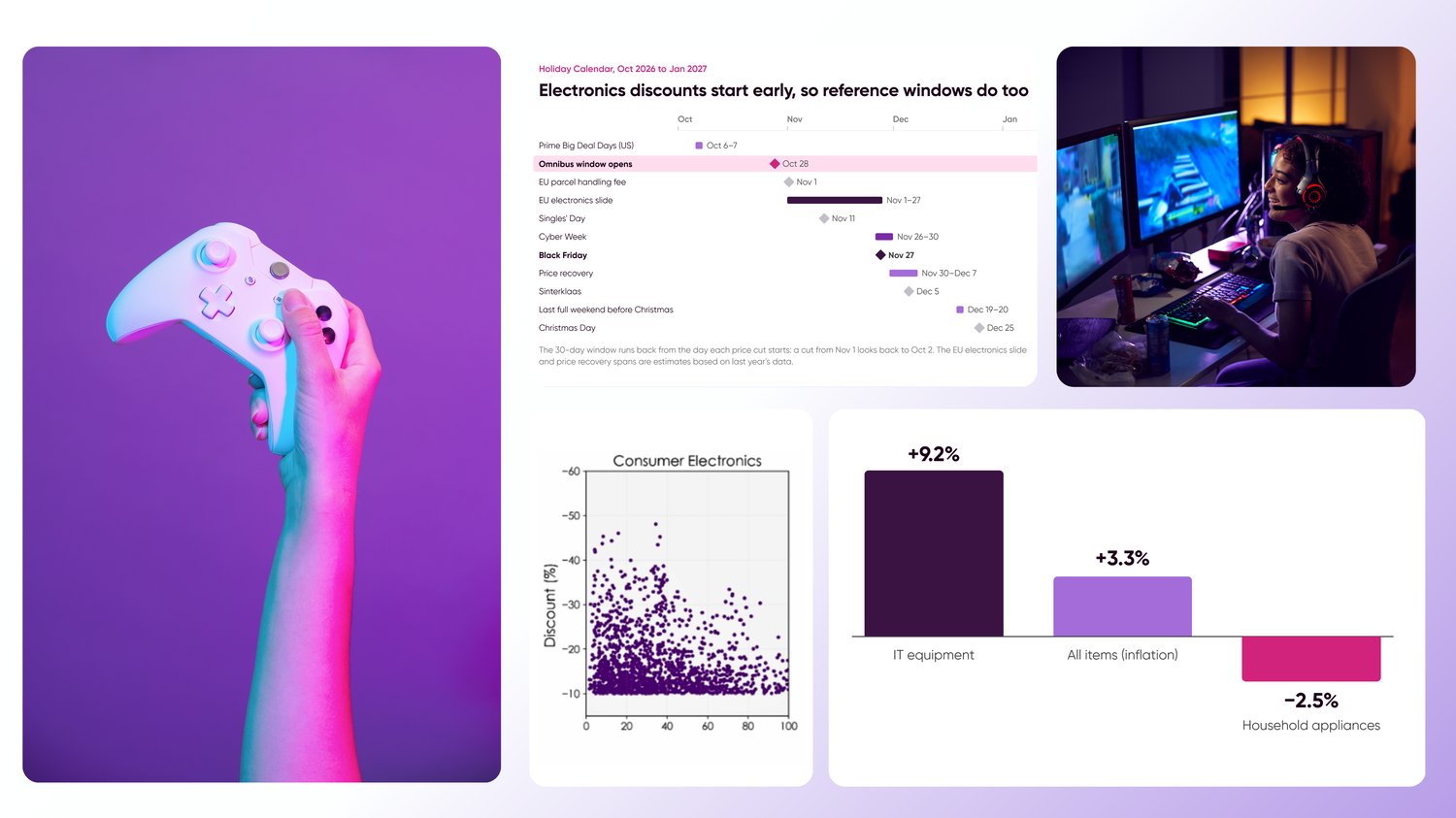
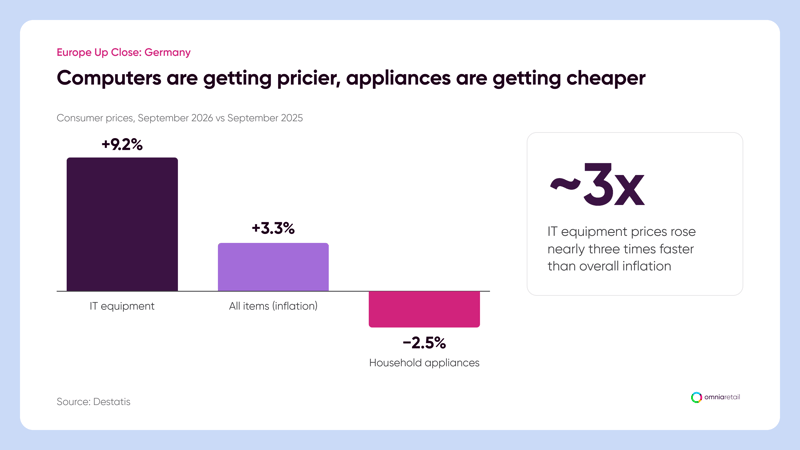
Computers already cost more. German consumer prices for IT equipment were up 9.2% in September, nearly three times overall inflation of 3.3%, according to Destatis. Household appliances, meanwhile, got 2.5% cheaper.
Download the Full Report as Slide Deck
German shoppers feel poorer than they are. Wages are rising faster than prices, but confidence is low, so Bain expects German holiday sales to grow just 2.0%, the weakest of the markets it covers. Where people start shopping is shifting too: 29% plan to begin on a generative AI platform, against 68% on Amazon.
UK
UK prices are creeping up again. Non-food shop prices rose 1.7% in October, more than double September's 0.8%, according to the BRC. Bain expects UK holiday sales to grow 3.5%, mostly from higher prices, though electronics should grow through volume. The EU's 30-day rule doesn't apply in the UK, so don't run UK and EU strike-throughs off the same template.
What Europe's electronics retailers reported
Ceconomy (MediaMarkt, Saturn). Black Season went well for the group: sales rose 3.4% to €7.6bn from October to December 2025, and online passed 30% of sales for the first time outside lockdowns. Gaming hardware, computers and floor care sold best. The growth came from countries like Spain, Italy and Türkiye, while shoppers in the rest of the DACH region held back, the company says. On Nov 3, JD.com cleared the last hurdle to take over the group.
Coolblue. Sales grew, profit didn't. Revenue rose 4.2% to about €2.56bn in 2025 while EBITDA fell 11.6%, ANP reported. Germany is where Coolblue wants to grow next.
Currys. The UK chain is growing, with like-for-like sales up 6% in the UK and Ireland over the summer. It also saw the price rises coming. In July, then-CEO Alex Baldock told Reuters that pricier smartphones and laptops were inevitable because of the memory shortage, and that Currys had stocked up early to cover supply until at least September.
Black Friday Pricing From the POV of a Philips Pricing Manager. Watch the Full Interview.

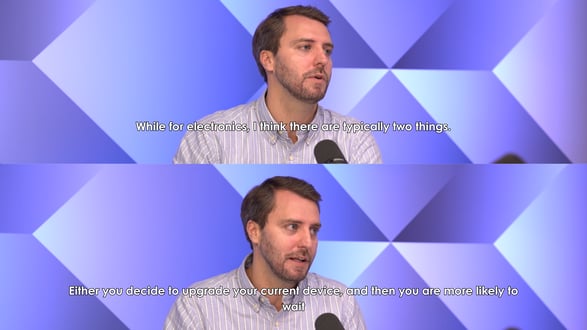
Edoardo Passerini runs D2C pricing for Philips Personal Health in 14 countries. In electronics, he sees discount claims of up to 40 to 50%, against roughly 20 to 30% in fashion and sports, and brands putting something from every category on offer. Read the full interview.
The US and the brands: growth, pricier devices and the memory squeeze
Americans are still expected to spend more this year, and US retailers aren't planning smaller discounts. The more useful lesson for European pricing teams is on cost: the same memory crunch is pushing up device prices on both sides of the Atlantic.
|
Indicator (US) |
2026 forecast |
Source |
|---|---|---|
|
Online holiday sales, Nov 1 to Dec 31 |
$275.1bn, +6.7% |
Adobe |
|
Online electronics sales, Nov 1 to Dec 31 |
$63.3bn, +5.9% |
Adobe |
|
Peak online electronics discount |
30% off list (30.1% in 2025), best on Cyber Monday |
Adobe |
|
Peak TV/computer discounts |
TVs 23% (24.2%), best on Black Friday; computers 23% (22.8%), best on Cyber Monday |
Adobe |
|
Retail sales, Black Friday to Cyber Monday |
Over $85bn, +8.75%, against +4.5% for the whole season |
Bain |
|
Retail sales ex autos and gas, Nov 1 to Dec 24 |
+5.5%; online +11%, stores +3.6% |
Mastercard Economics Institute |
|
Electronics spending, 2026 so far |
+10.7% year on year |
Mastercard SpendingPulse |
|
Average gift spend |
$708, down 2% |
PwC |
Sources: Adobe, Bain, Mastercard, PwC.
Part of that growth is just higher prices. The Mastercard Economics Institute reckons 2.8 points of its 5.5% growth forecast is inflation. Electronics shows why: AI's appetite for memory chips has pushed the US price index for computers and audio-video gear up 12.2% in a year, in a category where prices usually fall. German IT prices are moving the same way.
Cheap devices take the biggest hit. Memory made up 16% of what it cost to build a PC in 2025, and Gartner expects it to reach 23% this year. Premium devices have the margin to absorb that. Budget ones don't, which is why Gartner expects entry-level phones to suffer most and PCs under $500 to disappear by 2028.
Fewer gadgets under the tree. In PwC's US survey, 41% of people buying for kids lean toward screen-free gifts, against 27% buying tech. And among shoppers using AI for their holiday shopping, 55% use it to compare prices.
What this means for you. Expect fewer and shallower cuts on entry-level laptops and phones, because the margin that used to fund them now goes into components. And if you raised list prices this autumn, remember that an EU discount is measured against the lowest price of the past 30 days. Last year's price doesn't count.
EU/UK vs US: same hunt for value, different peak days
Shoppers everywhere wait for the deal. What differs is how much they spend and how strict the rules are: the US is still forecast to grow, Germany lags, and only the EU ties every discount to a 30-day price history.
|
Dimension |
Netherlands |
Germany |
UK |
US |
|---|---|---|---|---|
|
Electronics signal |
14% wait until end of November for a TV, laptop or phone (Overstappen.nl survey) |
Ceconomy saw consumer restraint in the rest of DACH during Black Season 2025 |
Bain expects electronics growth of about 1 to 5%, driven by units |
Online electronics forecast $63.3bn, +5.9% (Adobe) |
|
Peak moment, 2025 (all categories) |
Run-up week: 37.8m iDEAL payments vs 6.25m on the day |
Black Friday: 48% planned to shop it |
Black Friday: +62% transactions vs the daily average |
Cyber Monday: $14.25bn online |
|
2026 holiday outlook |
No 2026 forecast published yet |
+2.0% (Bain) |
+3.5%, mostly inflation (Bain) |
+5.5% retail ex autos and gas (Mastercard); online +6.7% (Adobe) |
|
Discount rules |
EU 30-day lowest price, actively enforced by the ACM |
EU 30-day lowest price |
Outside the EU rule |
Not covered in this report |
Where they overlap. Discounting starts early everywhere. Dutch shoppers make more payments in the run-up week than on the day, our data shows electronics prices sliding from early November, and Adobe expects US Black Friday to grow faster than Cyber Monday because deals start sooner. On both sides, shoppers are also handing the comparing to AI: Adobe forecasts AI-referred clicks to US retail sites up 130%, and 29% of German online shoppers plan to start on an AI platform.
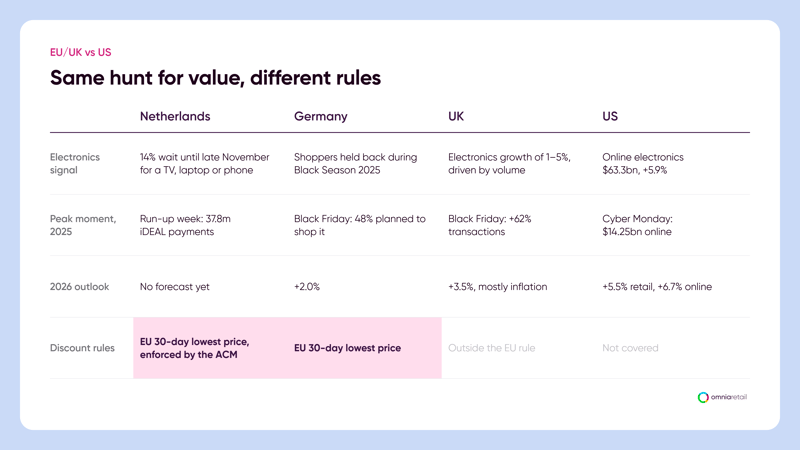
Where they split. US deals on electronics and computers peak on Cyber Monday, TVs on Black Friday. In the EU, every step down in price becomes part of the 30-day history your next discount is measured against. One global promo calendar risks over-discounting in cautious Germany or under-competing in the US.
Holiday calendar: from Singles' Day to Christmas
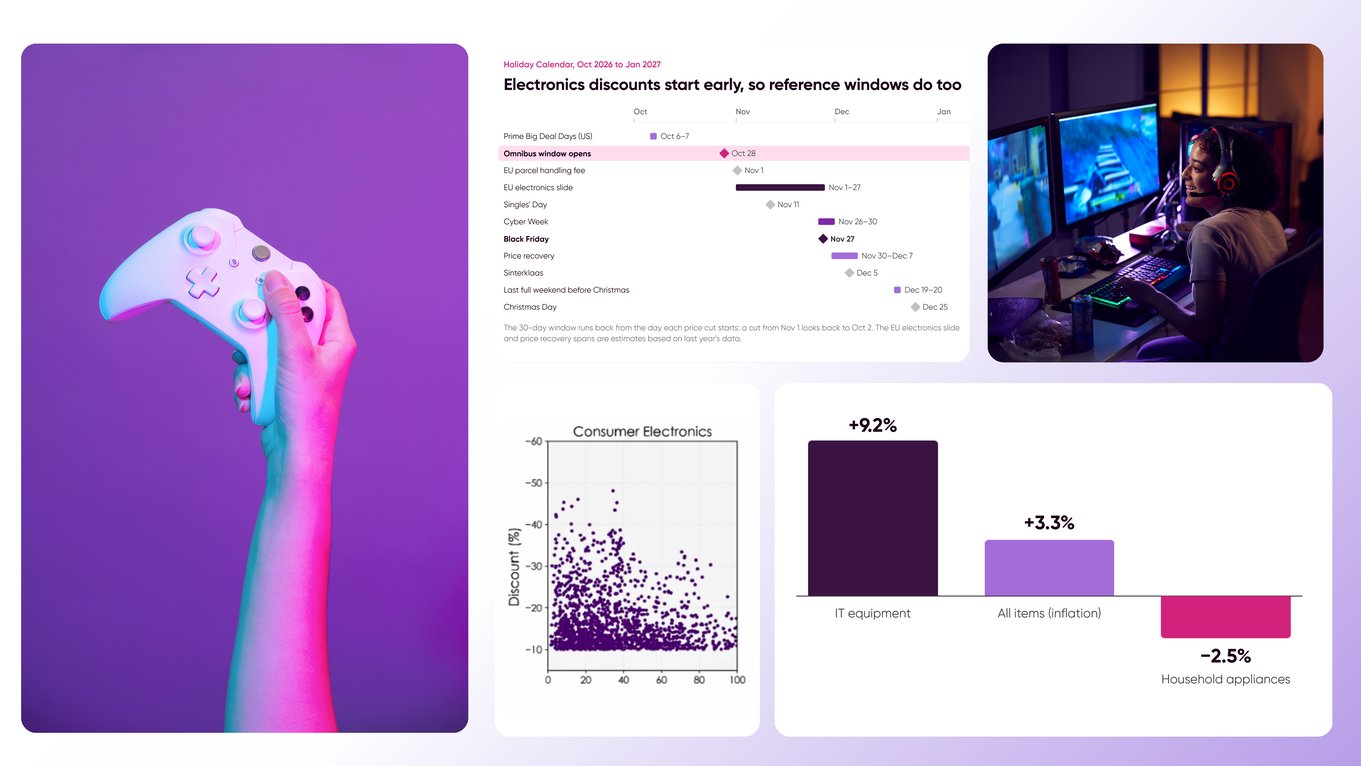
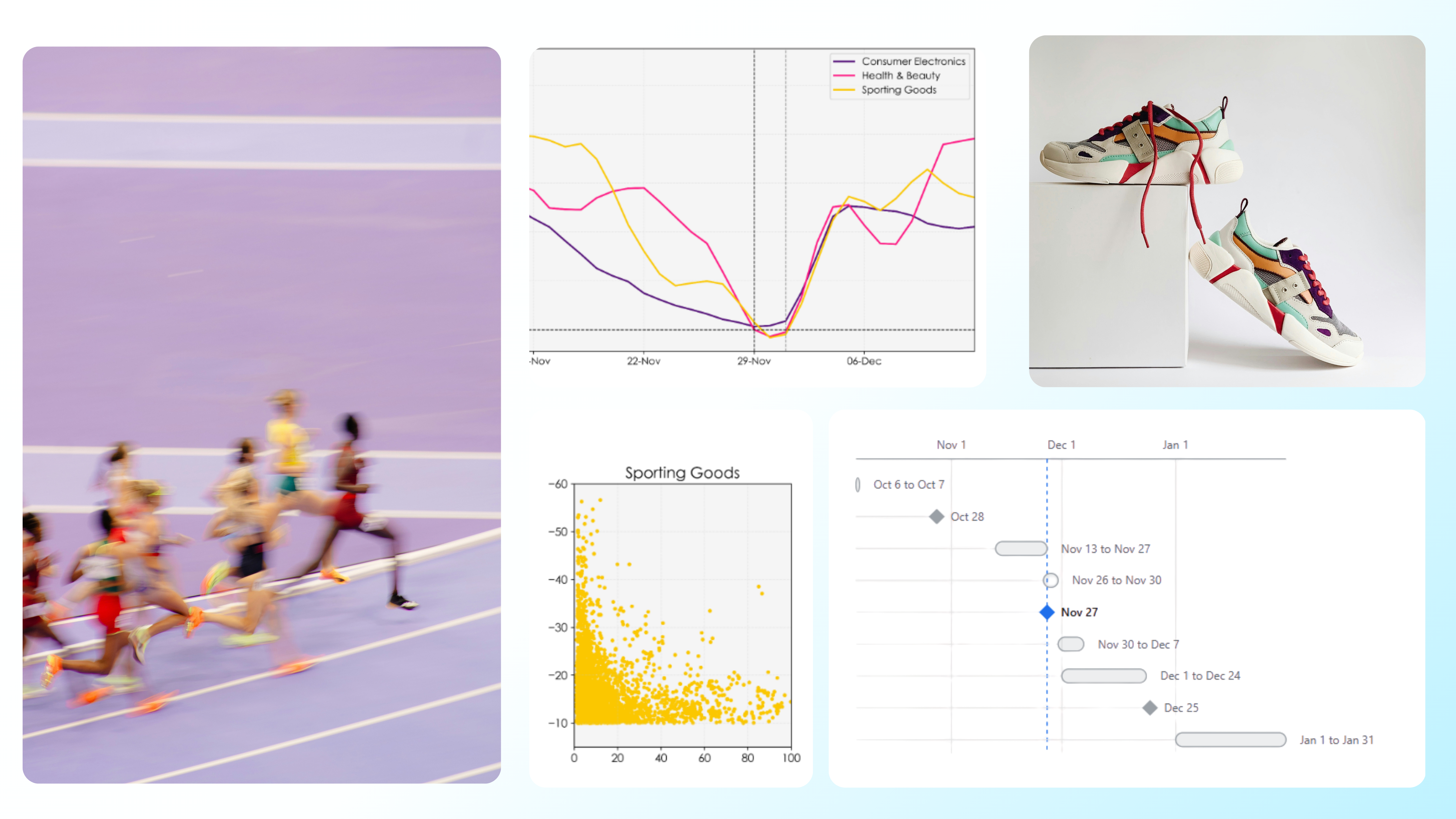
Black Friday is Nov 27 and Cyber Monday Nov 30, but electronics doesn't wait that long. Last year our electronics prices were already sliding at the start of November, which means the 30-day reference windows for this year's cuts open in early October.
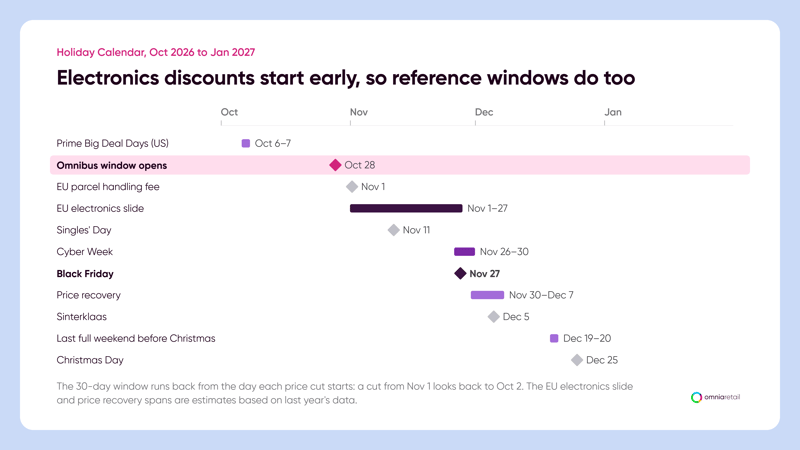 Footnote: The 30-day window runs back from the day each price cut starts: a cut from Nov 1 looks back to Oct 2. The EU slide span is an estimate based on last year's data.
Why the reference date matters more in electronics. EU rules say a discount must be measured against the lowest price of the 30 days before it. Countries can choose to treat a price that keeps dropping, step by step, as one campaign measured from before the first cut. That only works while the price keeps going down. In a category that slides gradually through November, one bounce back up mid-month changes the comparison.
The US discount ladder. Adobe expects deals to climb from up to 14% off in early November to 21% just before Thanksgiving and 30% during Cyber Week, then settle at 10 to 15% through December.
Sinterklaas and Christmas. Sinterklaas lands on Dec 5, just eight days after Black Friday, giving Dutch retailers a second gifting peak before Christmas. Christmas Day is a Friday, so Dec 19 to 20 is the last full shopping weekend. Late shoppers also seem less fussy about price: in US premium gift categories, the average transaction grew every day from Dec 15 until Christmas Eve, Mastercard found.
Last year's data: what Omnia saw in electronics around Black Friday 2025
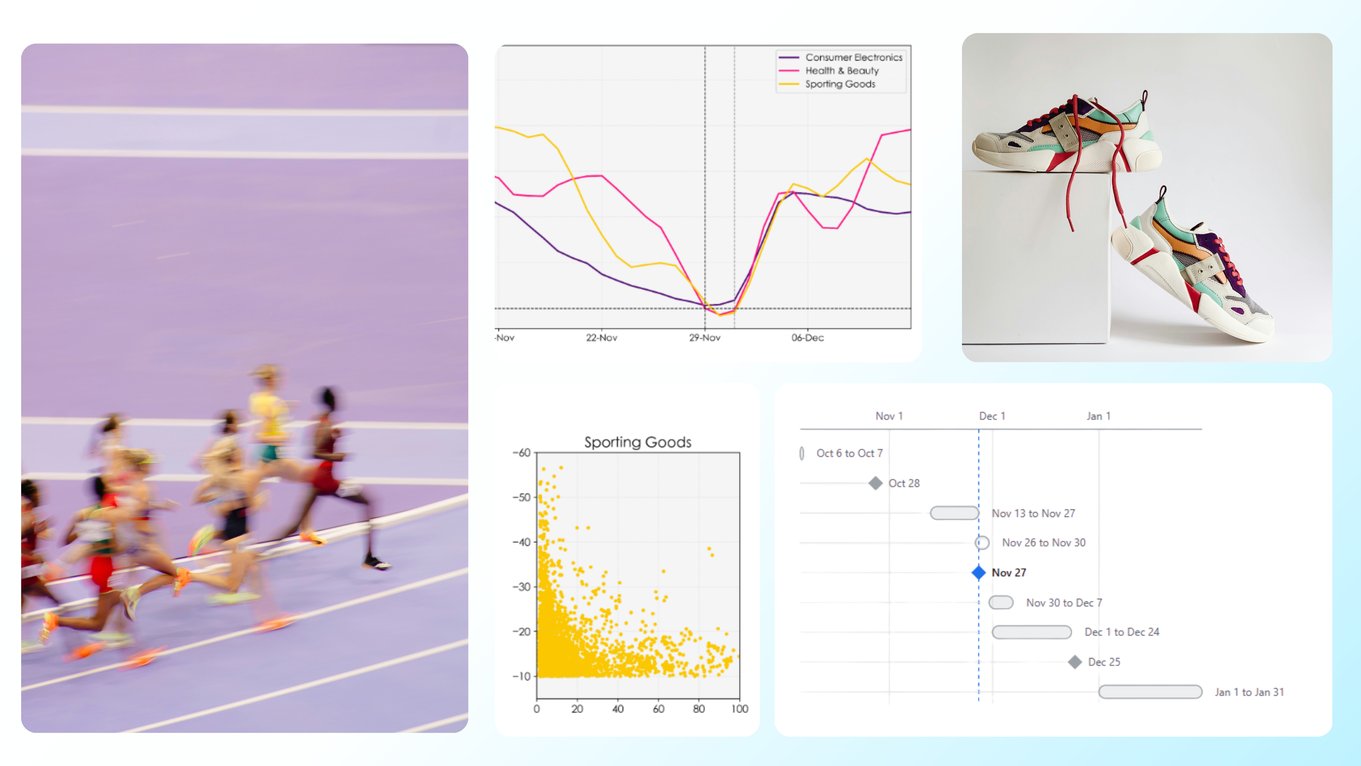
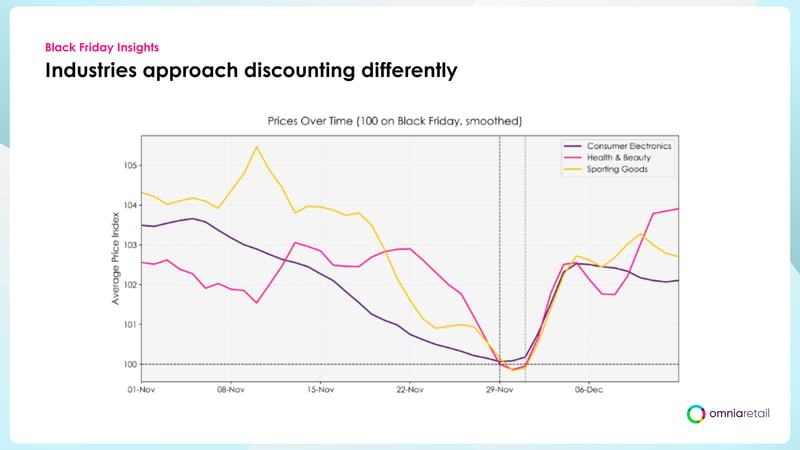
Electronics took the slow road to Black Friday. In our data, prices drifted down from early November without the early spike sporting goods had, then bottomed out on the day. We tracked roughly 60,000 products daily for six weeks around Black Friday 2025 in Germany and the Netherlands, across electronics, sporting goods and health & beauty.
|
Finding |
Consumer Electronics |
Sporting Goods |
Health & Beauty |
|---|---|---|---|
|
Run-up shape |
Earliest and most gradual decline, from the start of the window |
Prices climb first, peak about a month before Black Friday, then drop sharply in the final two weeks |
Flat for most of the window, sharp drop in the final week |
|
Share of catalogue under €50 / above €300 |
Spread evenly; 37% sits above €300 |
About half under €50 |
71% under €50 |
|
Does cheap get discounted more often? |
No strong skew once normalised |
Yes, clearly |
Yes, clearly |
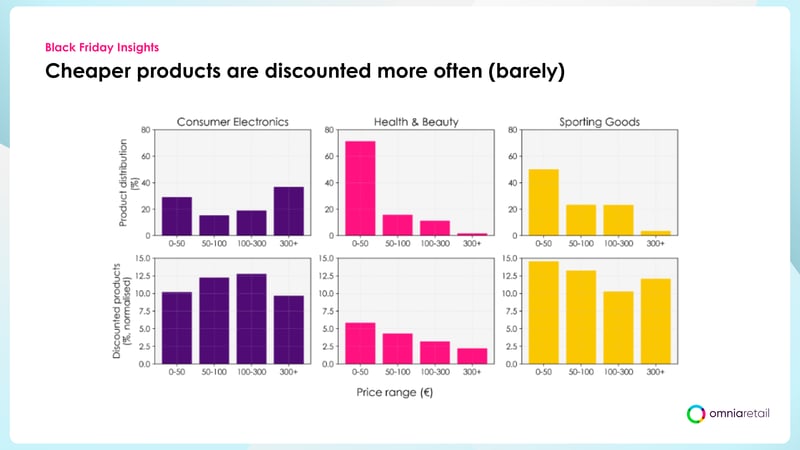
Electronics discounts are spread across the range. In sporting goods and beauty, cheap products got cut more often and harder. In electronics, once you account for how many products sit in each price bracket, every tier was discounted at about the same rate. Philips' Edoardo Passerini sees the same thing: brands put something from every category on offer. This year we expect the entry tier to break the pattern, because memory costs leave budget laptops and phones the least room to cut.
Three patterns across all three categories matter for this year's planning:
- The low point is Black Friday; the recovery comes with Cyber Monday. Indexed to 100 on Black Friday, prices climbed back to roughly 102 to 103 within about a week, most of it around Cyber Monday.
- Competition flattens discounts. Products with dozens of competing offers clustered at roughly 10 to 20% off. The 40 to 60% cuts showed up almost only on products with few competing offers.
- The pre-event slide is real. Prices started moving more than two weeks out, a pattern Omnia also saw around Prime Day 2026.
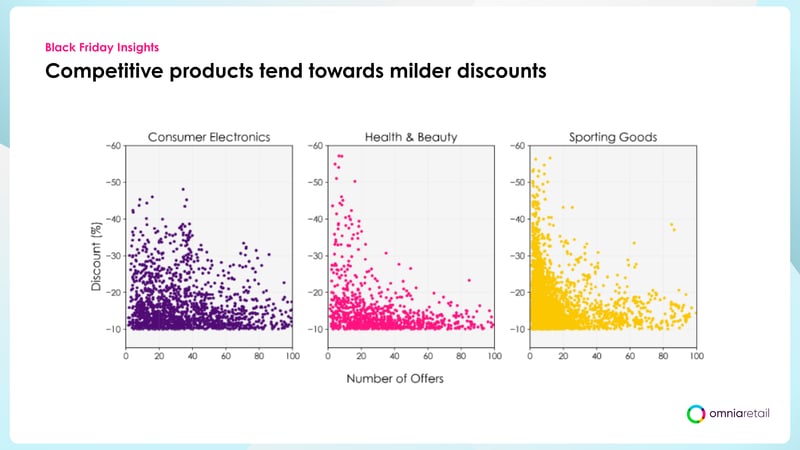
For electronics, the slow slide is the part to watch. A product cut in small steps from early November builds a price history that each next discount is measured against. The ACM specifically warns about sellers raising the old price before a sale to make the discount look bigger. So if you raised prices in October to pass on memory costs, check each one before it becomes the base for a Black Friday strike-through.
Marketplaces, comparison sites and agents: Who sets the electronics price now
Electronics is built for comparison: the same model number sits on dozens of shops. This season, three of the places where shoppers compare are changing at once: Google, Amazon and AI assistants.
Google Shopping looks different now. After a €460m fine under the EU's Digital Markets Act in July, Google pulled organic Shopping results across the EEA in mid-September, saying it had to. That was supposed to help comparison sites, but Beslist.nl says its Google traffic is actually falling. We expect more electronics comparing to move to idealo, Tweakers and Kieskeurig, and into paid Google listings. idealo is growing too, with launches in Switzerland and Ireland planned for early 2027.
Amazon's price controls in Germany are on hold. The Bundeskartellamt banned them in February, but Amazon doesn't have to comply until the Federal Court of Justice hears its application on Jan 26, 2027. So for this Black Friday, we expect Amazon.de to work the way it did last year.
JD.com is now in the room. The Chinese e-commerce giant cleared the last hurdle to take over MediaMarkt owner Ceconomy on Nov 3. Its own European webshop, Joybuy, already ran a "Summer Black Friday" in June in six countries, including the Netherlands and Germany. We expect more big promotions outside November, and more reasons to watch prices all year.
AI assistants compare your prices in seconds. Electronics suits them perfectly: one model number, dozens of sellers. Ask for "the best 55-inch OLED under €1,000" and an assistant lines up price, stock and delivery across shops. Adobe expects AI-referred clicks to US retail sites to rise 130% this season, and OpenAI says about 43% of ChatGPT shopping conversations involve comparing options. Retailers are split on letting agents in: Walmart says agents see the same prices as humans, while Amazon has blocked Meta's Muse agent. More on agents in our Singles' Day deep-dive.
New rules are coming, just not this season. The European Commission is expected to present its Digital Fairness Act on Nov 11, and a leaked draft includes rules on personalised pricing. It still has to pass the European Parliament and Council, so nothing changes for this Black Friday.
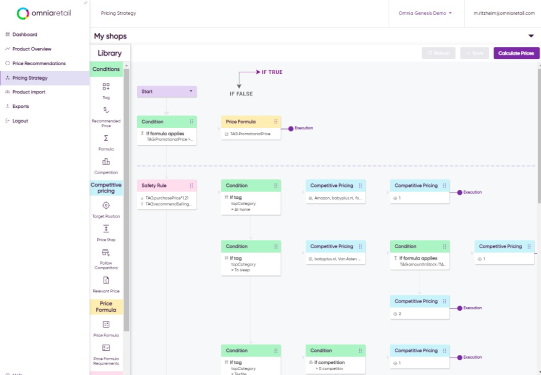
Your own agent for the pricing side. When the market moves daily, the bottleneck is often analysis time. The Omnia Agent, available to every Omnia customer in Omnia 2.0, lets you ask questions like "which competitors cut prices on my top 50 TVs since Singles' Day?" in plain language, and gives you an analysed answer with the reasoning. It's read-only, so decisions stay with your team.
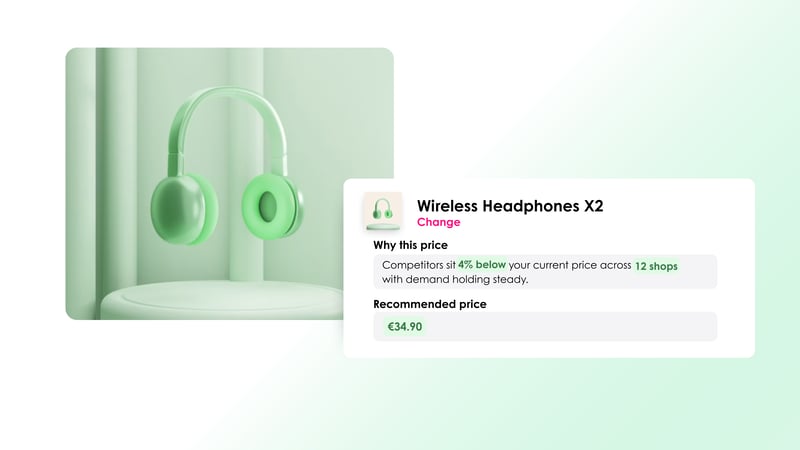
Omnia Agent in Omnia 2.0 answering a plain-language question about competitor price cuts on headphones
Forecast: What electronics pricing will likely look like this holiday season
Our read on 2026: a long, slow slide in Europe, fewer deep cuts on budget devices, and the hardest competition on the products everyone compares. These are our own calls, based on last year's data and current forecasts.
|
Prediction |
Confidence |
What it rests on |
|---|---|---|
|
Dutch and German shoppers spread purchases across November again, so the run-up week keeps growing while Black Friday itself sets no new record |
High |
iDEAL 2023 to 2025 run-up growth (all categories) |
|
European electronics prices drift down from early November, with no sharp late drop |
Medium |
Omnia Black Friday 2025 data: electronics had the earliest, most gradual decline |
|
Entry-level laptops and smartphones get fewer and shallower cuts than last year |
Medium |
Gartner's memory cost forecast; Currys' warning on price rises; our interpretation |
|
Heavily compared hero SKUs (flagship phones, popular TVs) settle around 10 to 20% off; deeper cuts land on less-compared lines |
Medium-high |
Omnia competition vs discount data, all three categories pooled |
|
Prices recover by about Dec 7, a week after Cyber Monday on Nov 30 |
Medium |
Omnia price index recovered to 102 to 103 within about a week last year |
|
US electronics discounts peak around 30% off list, best on Cyber Monday, with TV deals best on Black Friday |
Medium-high |
Adobe 2026 forecast |
|
Gaming and computer hardware stay among the strongest European categories |
Medium |
Ceconomy's Black Season 2025 quarter |
|
Germany stays the softest of the big European markets for electronics |
Medium |
Ceconomy's "consumer restraint" in DACH; Bain's +2.0% German forecast |
|
Ultra-cheap cross-border accessories put less pressure on EU prices than last year |
Low-medium |
€3 EU customs duty per item since Jul 1 and €2 handling fee from Nov 1; no post-fee volume data yet |
|
More EU scrutiny of strike-through prices |
High |
The ACM found misleading claims at 18 of 24 s |
Pricing playbook for electronics brands and retailers
The setup for 2026: price the long slide deliberately, protect margin where memory costs bite, compete hard only where shoppers compare hardest, and check every reference price before it goes live.
- Map the 30-day window for every step down. The window runs back from the day each cut starts: Oct 28 for a Black Friday price, Oct 2 for a cut starting Nov 1. In a category that slides gradually, write down which cuts form one uninterrupted campaign and which prices go back up in between.
- Audit any autumn price increase. If you raised list prices to pass on memory costs, remember that a later discount is measured against the lowest price applied in the 30 days before it, so check what that lowest price actually was. The ACM found most misleading claims around the 'from' price.
- Protect the entry tier. Cheap laptops and phones carry the steepest cost increases, according to Gartner. Use bundles, accessories or vouchers before cutting the device price itself.
- Match the market on hero SKUs. Flagship phones, popular TVs and consoles have dozens of offers, and our data shows discounts there cluster at 10 to 20%. Going deeper buys little extra visibility.
- Use less-compared lines for headline deals. The 40%+ cuts in our data sat almost entirely on products with few competing offers. Previous-generation models and own-brand accessories are natural candidates.
- Watch comparison sites as closely as competitors. With organic Google Shopping gone in the EEA, check where your products rank on idealo, Tweakers, Kieskeurig and Beslist, and how often a marketplace seller undercuts you there.
- Plan the recovery and the second peak. Prices recovered within about a week last year. Schedule step-backs from Cyber Monday, then decide separately what you run for Sinterklaas on Dec 5 and the last weekend before Christmas.
- Make product data agent-readable. Model numbers, specs, price, stock and delivery times are exactly what an AI assistant lines up. Keep them current wherever an assistant might read them.
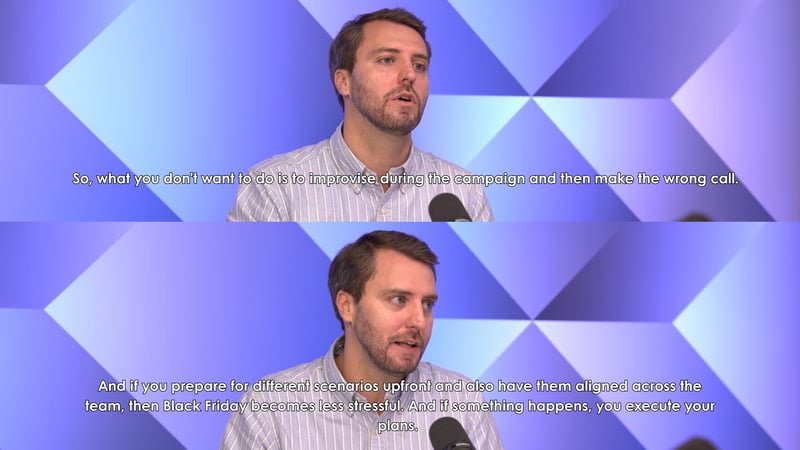
Our full Black Friday interview with Philips
About the data
Omnia's Black Friday figures come from daily pricing data on roughly 60,000 products in Germany and the Netherlands, tracked for six weeks around Black Friday 2025 across three categories. Where a finding covers all three categories rather than electronics alone, the text says so. Our Prime Day figures come from a separate, Europe-wide dataset and are never combined with the Black Friday data. Figures from Adobe, Bain, Gartner, HDE and Mastercard are forecasts, US figures cover the US only, and statements from Overstappen.nl, OpenAI, Walmart and the retailers named are their own data. This article describes the EU 30-day price rule but isn't legal advice.
Sources
Omnia: Black Friday Pricing Data Report 2025 · Prime Day 2026 Pricing Data · Singles' Day 11.11 · Philips interview · Agentic pricing
External: Adobe 2026 forecast · Adobe 2025 recap · Bain US Black Friday forecast · Bain European Holiday Outlook · Mastercard Economics Institute · PwC Holiday Outlook 2026 · Gartner · Destatis · HDE Christmas forecast via Reuters · HDE 2025 BF/CM · Ceconomy Q1 2025/26 · Ceconomy ad hoc, Nov 3 · Currys trading update · Coolblue yearbook · Overstappen.nl · iDEAL · Thuiswinkel Markt Monitor · ACM · BRC · Barclays via The Irish News · European Commission, EU Customs Reform · European Commission, DMA decision · Emerce, Google Shopping · Emerce, Beslist.nl · Moneycab, idealo · Bundeskartellamt · BGH press release 201/2026 · European Parliament Legislative Train, DFA · DFA leak analysis · EUR-Lex, Price Indication Directive · Walmart · Axios · OpenAI · Joybuy