Holiday 2026 is shaping up as a long, cautious season for sporting goods in Europe. Dutch shoppers now spread their deal-hunting across most of November, German Black Friday spending was forecast to fall for the first time last year, and JD Sports saw European demand soften in early December. Add a promotional footwear market and regulators checking strike-through prices, and pricing teams have little room for error.
Key Findings
- Black Friday is now Black November. iDEAL processed 37.8m payments in the week before Black Friday 2025, up from 28.6m in 2023, while the day itself stayed below its 2023 record.
- More shoppers, smaller totals. HDE forecast German BF/CM spend down almost 2% in 2025 even as more people planned to take part.
- Footwear is the weak spot. JD Sports and Dick's both flagged heavy promotions in athletic footwear; Dick's says it turned increasingly promotional during its May to July 2026 quarter.
- Regulators are watching. The Dutch ACM found misleading discount claims at 18 of 24 large sellers it checked before Black Friday 2025.
- Sporting goods move differently. In Omnia's DE/NL data from Black Friday 2025, sporting goods prices rose before they fell, and the under-€50 tier took the most and deepest cuts.
- US discounts edge up. Adobe expects US sporting goods discounts to peak at 19% this season, against 17% on Cyber Monday 2025.
Europe up close: the Netherlands, Germany and the UK
Across Europe's core markets, last year's season looked the same in three different datasets: shoppers turned up for deals, but they spread purchases out and spent carefully.
Netherlands
The run-up now matters more than the day. Dutch consumers made 6.25m iDEAL payments on Black Friday 2025, up from 5.82m in 2024 but below the 7.13m record of 2023. In the seven days before, they made about 37.8m payments, against 36.3m in 2024 and 28.6m in 2023, and Cyber Monday added another 5.5m. Many experts started referring to Black Friday as Black Week, or even Black November.
Fewer people buy than you'd think. NIQ's survey of 12,500 Dutch consumers found 28% bought something on Black Friday 2024. For 2025, 10% said they would definitely buy and 38% might; nearly 40% planned to buy nothing, mostly because they didn't need anything (61%) or disliked the commercial nature of it (44%). Clothing (32%) and shoes (19%) topped the planned categories, and 5% had already made a Black Friday purchase by Nov 15.
November may borrow from December. ING economist Katinka Jongkind warned that higher November sales may come at the expense of December, as consumers wait for November discounts. That matters more in the Netherlands than elsewhere, because Sinterklaas gift-giving lands in early December, before Christmas.
Online is flat, cross-border is growing. Dutch consumers spent €35.7bn online in 2025, down 1%, though spending on products rose 2%. Cross-border purchases grew 9% to 44.8m, with Chinese webshops taking 31% of them, and Shoes & Personal Lifestyle among the fastest-growing cross-border categories. Smartphones handled 41% of online purchases, and iDEAL becomes Wero in 2026.
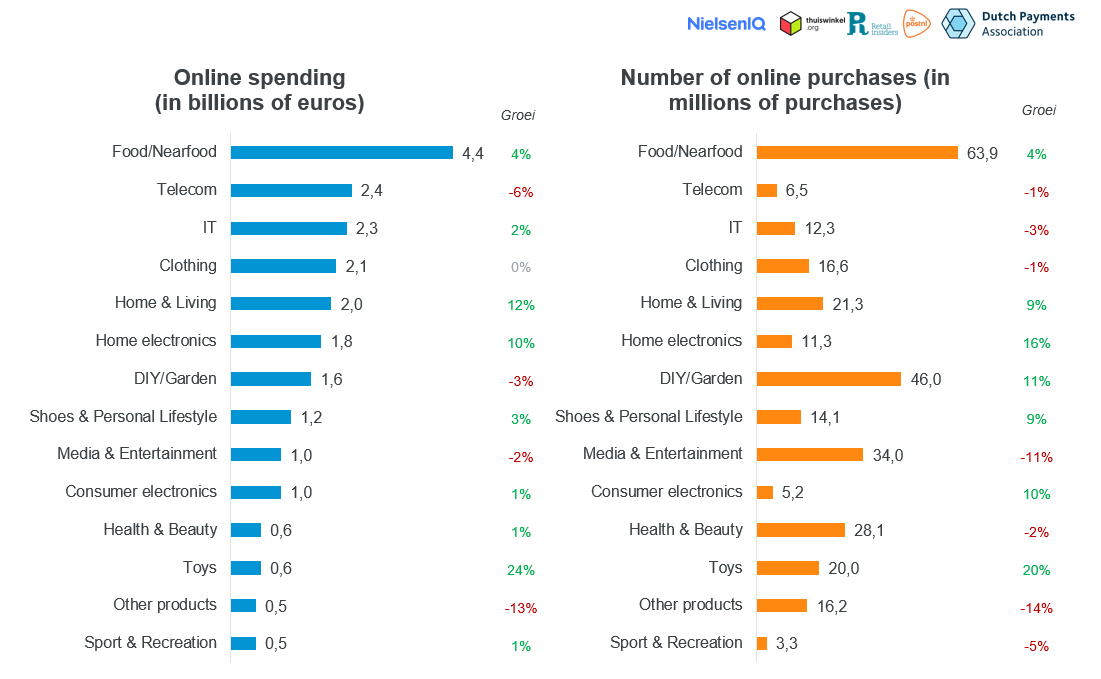 Online spending on products in billions of euros.
Source: Dutch Payments Association
The ACM is enforcing the 30-day rule. Ahead of Black Friday, Sinterklaas and Christmas 2025, the ACM checked 24 large sellers across home, clothing, DIY, household electronics and cosmetics. It found misleading price claims at 18 of them, mostly around the 'from' price, which must be the lowest price charged in the previous 30 days. A Dutch court also upheld ACM fines on two webshops for fake discounts that month.
Germany
For Black Friday and Cyber Monday 2025, HDE forecast €5.8bn in sales, down almost 2% and the first decline since its tracking began in 2016. Participation still rose slightly: 48% planned to shop on Black Friday and over a third on Cyber Monday, and 54% said they would use Black Friday for Christmas shopping. The survey behind it was run by IFH Köln among more than 1,000 online shoppers in October 2025. HDE published that forecast on Nov 17, so its 2026 view is likely a few weeks away.
Black Friday pricing from the POV of a Philips pricing manager. Sign up for our webinar on Oct 15th!
.png)
UK
Black Friday 2025 was the UK's busiest day of the year so far for transactions, up 62% on the daily average, yet 68% of adults doubted the real value of BF/CM deals (The Irish News, reporting Barclays). Sensormatic counted 3% fewer store visits on the day than in 2024, though visits across the full weekend were up 0.7% (TheIndustry.fashion).
What Europe's sports retailers reported
Last winter. JD Sports' peak-season update gives a direct read on European sporting goods over the holidays. In the nine weeks to Jan 3, 2026, like-for-like sales fell 3.4% in Europe and 5.3% in the UK. JD cited higher promotional participation around Black Friday, challenging trading in Germany and softer demand in the first half of December, before targeted price investments lifted sales near Christmas.
This year so far. The pressure hasn't eased. In the 26 weeks to Aug 1, 2026, JD's European like-for-like sales fell 3.3%, and UK like-for-likes fell 1.4%, in what JD called a highly promotional market. Footwear, 60% of group sales, fell about 3%, while apparel and accessories grew about 4%. JD kept making what it calls controlled price investments, mainly online, which cost about 0.5 points of gross margin. Its sporting goods chains in Spain, Portugal, Greece and Cyprus were the exception, with like-for-like sales up 4.7%. JD also completed a restructuring in Germany, cutting its JD store estate there from 91 to 62, and warns the promotional backdrop may persist into the second half. Its next trading statement, on Nov 19, will be the first read on this season.
Premium brand On did better. In Q2 2026, its EMEA net sales grew 15.4% to CHF 228.2m, or 20.5% at constant currency, against 4.5% in the Americas.
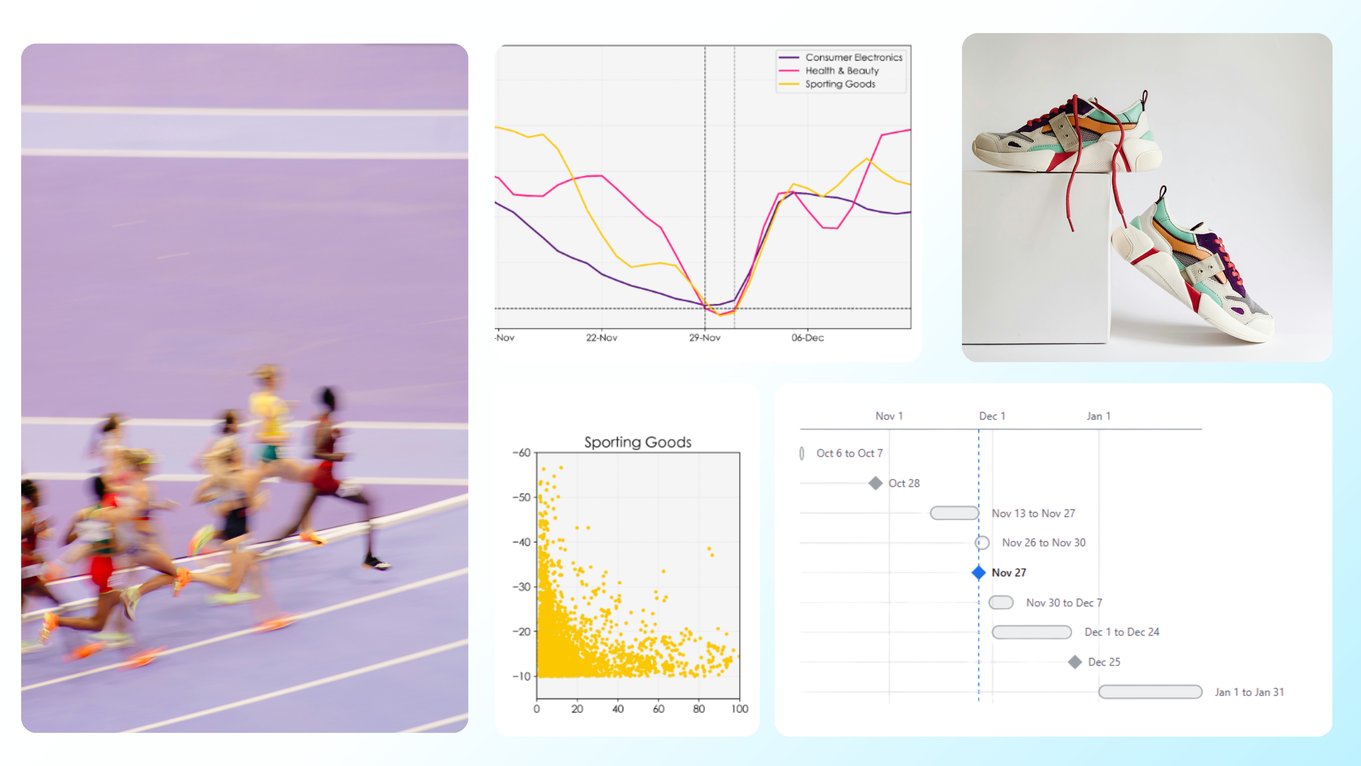
All three categories converge to roughly the same point right around Black Friday itself, but they take very different paths to get there.
The US and the brands: growth, value and hotter footwear promos
The US is still forecast to grow its holiday spend, while shoppers there say they will cut back on gifts. For European pricing teams, the US matters mostly as a signal: the same brands, the same footwear cycle and the same AI shopping tools reach both markets.
|
Indicator |
2026 forecast |
|---|---|
|
US online holiday sales (Nov 1 to Dec 31) |
$275.1bn, +6.7% |
|
Peak US sporting goods discount |
19% off list, best deals on Thanksgiving |
|
US average gift spend |
$708, down 2% from $721 |
|
US total holiday retail sales |
+4% to +4.8% |
|
US retail sales ex autos and gas (Nov 1 to Dec 24) |
+5.5%; online +11%, stores +3.6% |
US sporting goods last year. On Cyber Monday 2025, US online sporting goods sales reached $0.6bn, up 6.0%, with discounts peaking at 17% off list. Between Nov 1 and Dec 1, 2025, the share of units sold from the most expensive sporting goods rose 52%.
Footwear is the pressure point. Dick's Sporting Goods said athletic footwear and apparel became increasingly promotional during its Q2 FY26 (13 weeks to Aug 1, 2026). The core Dick's business grew comps 4.9%, but Foot Locker comps fell 3.6%, and Dick's cut its Foot Locker outlook to between -2% and flat. JD Sports sees the same in Europe: footwear sales fell about 2% there and about 6% in the UK in the six months to Aug 1, 2026, which JD put down to end-of-cycle product lines and a promotional market.
Premium is holding its line. On's Q2 2026 net sales rose 13.5% to CHF 850.3m, or 21.6% at constant currency, with a 65.4% gross margin while absorbing higher US import tariffs. Its CFO said the company does not compromise its full-price integrity for volume, even in what he called a heavily promotional environment in some markets, and On says it is deliberately managing wholesale sell-in to protect full prices.
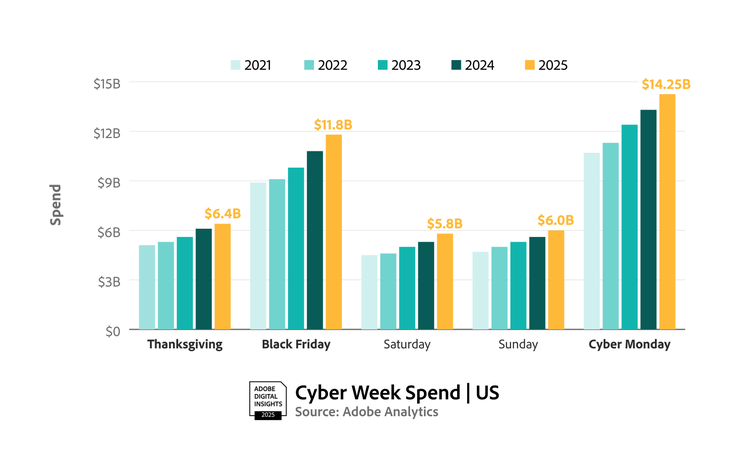 Cyber Monday Hits Record $14.25 Billion in Online Spending with Over $1 Billion Driven by Buy Now Pay Later.
Source: Adobe
Mass retail is leading on value. Target is cutting prices on nearly 2,000 home, apparel, and accessories items, after more than 10,000 reductions in the past year, and runs Target Circle Deal Days on Oct 6-7 against Amazon's Prime Big Deal Days. Adobe expects that October event to drive $9.9bn in US online sales.
EU/UK vs US: same hunt for value, different peak days
Shoppers on both sides are chasing value and buying earlier, but the US is still growing its holiday spend while Europe's numbers were mixed last year. For pricing teams, the biggest practical difference is the EU's 30-day reference-price rule.
|
Dimension |
Netherlands |
Germany |
UK |
US |
|---|---|---|---|---|
|
Peak moment, 2025 |
The week before Black Friday: 37.8m iDEAL payments vs 6.3m on the day |
Black Friday: 48% planned to shop it, just over a third on Cyber Monday |
Black Friday: busiest day of the year so far for transactions, +62% on average |
Cyber Monday ($14.25bn online), with Black Friday growing faster for two years |
|
2025 spend direction |
Online spend €35.7bn for the year, -1% |
BF/CM forecast €5.8bn, about -2% |
BF weekend forecast £9.5bn, +4.2%; store visits on the day -3% |
Cyber Week online $44.2bn, +7.7% |
|
Shopper mood |
Nearly 40% planned to buy nothing on Black Friday |
More buyers, lower total spend |
68% doubt the value of BF/CM deals |
2026 gift budgets forecast down 2% |
|
Discount rules |
EU 30-day lowest price, actively enforced by the ACM |
EU 30-day lowest price |
Not covered in this report |
Not covered in this report |
Sources: iDEAL, NIQ, Thuiswinkel Markt Monitor, ACM, HDE press release, Barclays via The Irish News, Sensormatic via TheIndustry.fashion, Adobe 2025 recap, PwC via Retail TouchPoints.
Where they overlap. Early discounting is standard everywhere. Adobe's analyst said early, competitive deals pushed US shoppers to buy sooner, Dutch payment data shows the same shift into the run-up week, and Omnia's European price data shows prices sliding more than two weeks out. AI-assisted shopping is the other shared trend: Adobe forecasts US AI-referred retail traffic up 130% this season, and PwC finds 55% of AI-using US shoppers use it to compare prices.
Where they split. US growth still comes from volume and trading up to pricier items. Europe was more mixed in 2025: HDE forecast lower German BF/CM spend, UK store visits fell on Black Friday, and Dutch online spend dipped 1% for the year, even though Dutch Black Friday payments and the UK weekend spend forecast both rose. In that setting, protecting margin on the core range is worth more than chasing extra units. A brand running one global discount calendar risks over-discounting in Europe or under-competing in the US.
Holiday calendar: from October deal days to Christmas
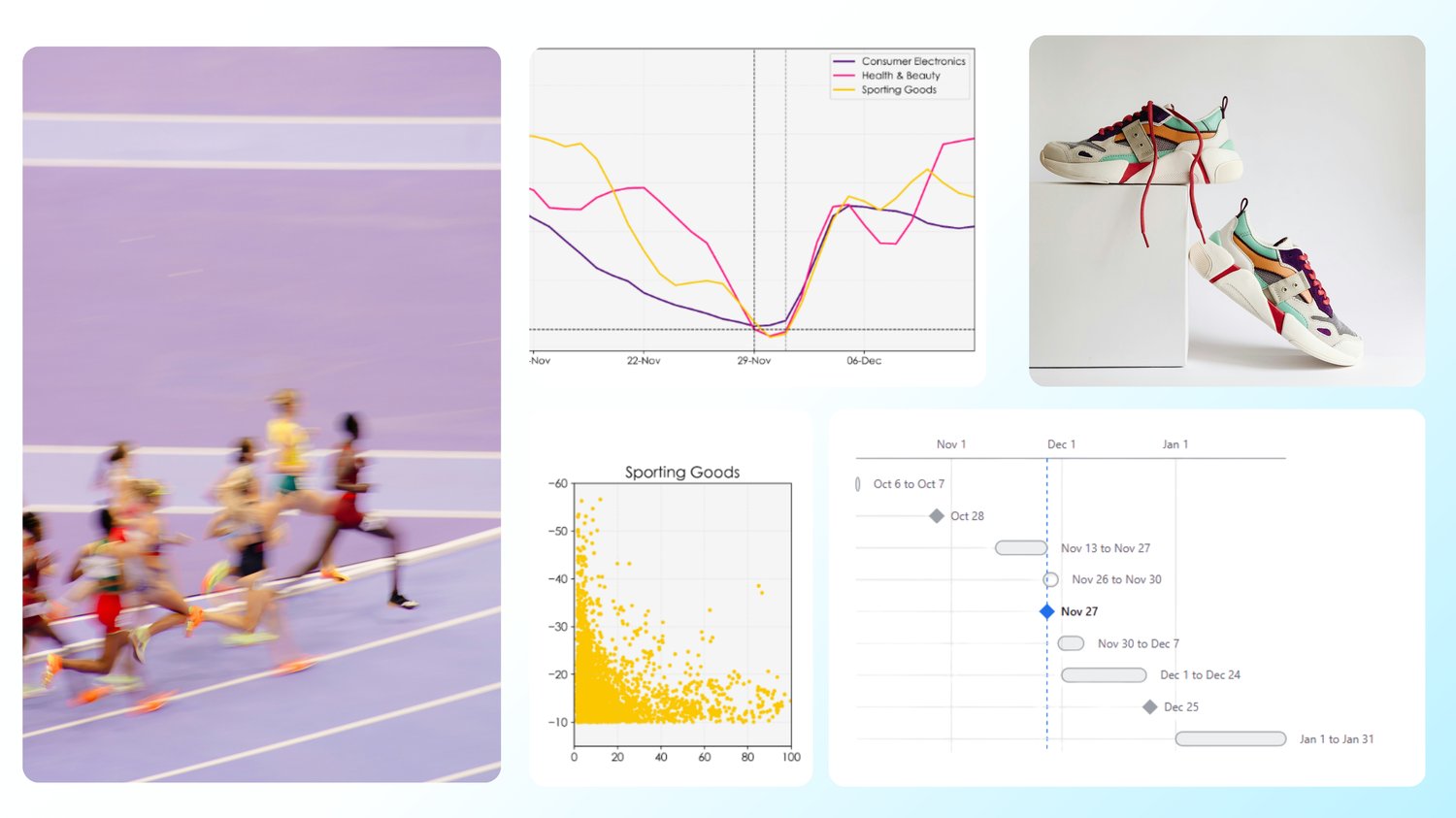
The pricing season now opens with October deal events and runs to Christmas, with Black Friday on Nov 27 and Cyber Monday on Nov 30. For EU sellers, the date that matters most is Oct 28, when the Omnibus 30-day reference window opens for a discount that starts on Black Friday. The window runs back from the day each price cut starts, so a cut from Nov 13 looks back to Oct 14.
The EU drop span is an estimate based on last year's two-week decline; the other dates are fixed or forecast.
Discount ladder (US, Adobe 2026 forecast). Deals run up to 14% in early November, up to 21% just before Thanksgiving, peak at 30% during Cyber Week, then settle at 10-15% through December. Sporting goods tops out at 19%, with the best deals on Thanksgiving, Nov 26 (Retail TouchPoints).
Sinterklaas and Christmas. In the Netherlands, Sinterklaas on Dec 5 adds a second gifting date before Christmas, and the ACM explicitly timed its discount checks around Black Friday, Sinterklaas, and Christmas. After Cyber Week 2025, US sporting goods discounts still ran at 15% into the first week of December. JD Sports saw European and UK demand soften in the first half of December 2025, then recover near Christmas after targeted price cuts. Christmas Day falls on a Friday this year, which makes Dec 19-20 the last full shopping weekend.
Last year's data: what Omnia saw around Black Friday 2025
.png?width=800&height=450&name=Black%20Friday%202025%20Recap%20(2).png)
Sporting goods took a different road to Black Friday than the other two categories Omnia tracked: prices rose first, peaked about a month out, then fell hard in the final two weeks. That is the core finding from Omnia's analysis of roughly 60,000 products tracked daily for six weeks around Black Friday 2025 across Germany and the Netherlands, covering Consumer Electronics, Sporting Goods and Health & Beauty.
|
Finding |
Sporting Goods |
Consumer Electronics |
Health & Beauty |
|---|---|---|---|
|
Run-up shape |
Prices climb first ~2 weeks, peak ~1 month before BF, then drop sharply in final 2 weeks |
Earliest and most gradual decline |
Flat for most of the window, sharp drop in final week |
|
Share of catalog under €50 |
About half |
Spread evenly; 37% sits above €300 |
71% |
|
Does cheap get discounted more often? |
Yes, clearly |
No strong skew once normalised |
Yes, clearly |
|
Where the deepest cuts (40-50%+) land |
Concentrated in cheapest tiers |
Not called out separately |
Concentrated in cheapest tiers |
.png?width=800&height=450&name=Black%20Friday%202025%20Recap%20(3).png)
Watch the full 2025 Black Friday webinar
Three market-wide patterns matter for this year's planning:
- The low point is Black Friday; the recovery is Cyber Monday. Indexed to 100 on Black Friday, prices climbed back to roughly 102-103 within about a week, most of it around Cyber Monday.
.png?width=800&height=450&name=Black%20Friday%202025%20Recap%20(1).png)
- Competition flattens discounts. Products with dozens of competing offers clustered at roughly 10-20% off. The 40-60% cuts showed up almost only on products with few competing offers.
.png?width=800&height=450&name=Black%20Friday%202025%20Recap%20(5).png)
- The pre-event slide is real. Prices started moving more than two weeks out, a pattern Omnia also saw around Prime Day 2026.
For sporting goods, the pre-Black Friday price rise is the detail worth putting in a headline, and also the one to handle with care. Under the EU rules, an announced discount must be measured against the lowest price of the previous 30 days. The ACM's consumer guidance warns specifically about sellers raising the old price before a sale to make the discount look bigger (ACM), so a category that peaks about a month out needs its reference prices checked line by line.
Omnichannel and DTC: one price across every channel
The big sporting goods retailers keep investing in stores and in linking them to online, so holiday prices have to hold up wherever a shopper checks.
Stores are being rebuilt as places to play sport. Dick's opened Lids shop-in-shops in nearly 50 stores in June with a plan for 100+ by the end of summer, and keeps expanding House of Sport. Foot Locker and Nike opened The Crenshaw Rec in Los Angeles, modelled on a neighbourhood rec centre (Retail Dive). Retail Dive also cites EY research putting offline at around three-quarters of total retail sales.
Stores and online are merging in Europe too. JD Sports credits its European online sales partly to ship-from-store orders, and in the first half of 2026 its automated distribution centre in Heerlen, in the Netherlands, started fulfilling online orders as well as store orders. Online grew to 20% of JD's group sales. In the UK, its online business was hit by market-driven footwear promotions, while stores held up better (JD Sports half-year results).
What this means for holiday pricing:
- Keep hero SKUs aligned across channels. Omnia's data shows products with dozens of competing offers settle at 10-20% off, so heavily resold SKUs leave a brand little room for a separate DTC discount.
- Know which reseller sets the price. Brands sell against marketplaces, resellers, and other DTC players at once (Omnia), so tracking who undercuts most often on hero SKUs is worth doing before November.
- Watch cross-border offers in the Netherlands. Dutch cross-border purchases grew 9% in 2025, with Shoes & Personal Lifestyle among the fastest-growing categories (Thuiswinkel Markt Monitor). A foreign webshop can set the market price on a SKU you thought was only competing locally.
- Match store prices by evening. In the UK, MRI recorded a 29.2% week-on-week jump in visits between 5 pm and 8 pm on Black Friday 2025.
Forecast: what sporting goods pricing will likely look like this season
Our read for 2026: a long, early, cautious season in Europe, with the deepest cuts on cheap and footwear SKUs and premium brands holding price. These are Omnia's inferences from last year's data and current forecasts, not published forecasts, so each row names what it rests on.
|
Prediction |
Confidence |
What it rests on |
|---|---|---|
|
Dutch and German shoppers spread purchases across November again, so the run-up week keeps growing while Black Friday itself sets no new record |
High |
iDEAL 2023-2025 run-up growth; NIQ's "Black Month" finding |
|
European sporting goods repeat the two-stage pattern: prices firm into early November, then fall sharply from about Nov 13 to Black Friday on Nov 27 |
Medium |
Omnia's Black Friday 2025 data: a peak about a month out, then a sharp two-week drop |
|
Athletic footwear sees the deepest and earliest markdowns, especially end-of-cycle styles |
Medium-high |
Dick's flagged heavy footwear promotions and cut its Foot Locker outlook; JD's footwear sales were still falling in Europe and the UK through Aug 2026 |
|
Products under €50 carry the most discounts and the steepest cuts |
High |
Omnia's price-tier data for sporting goods |
|
Highly compared SKUs stay at 10-20% off; 40%+ cuts appear on niche lines |
High |
Omnia's competition vs discount depth data |
|
Prices recover by about Dec 7, a week after Cyber Monday on Nov 30 |
Medium |
Omnia's price index recovered within about a week last year |
|
Early December stays soft in Europe, especially in the Netherlands around Sinterklaas |
Medium |
JD Sports' weak first half of December 2025 and its warning that promotions may persist into the second half; ING's warning that November sales borrow from December |
|
More regulatory scrutiny of strike-through prices in the EU |
High |
The ACM found misleading claims at 18 of 24 sellers in 2025 and says it is continuing its investigation |
|
Premium running and outdoor brands hold list price |
Medium |
On's Q2 2026: 65.4% gross margin and a stated refusal to trade full-price integrity for volume |
|
US sporting goods discounts peak around 19%, up from 17% on Cyber Monday 2025 |
High |
Adobe's 2026 forecast vs its 2025 recap |
Pricing playbook for sporting goods brands and retailers
The setup for 2026 is tiered: compete hard on cheap, heavily compared SKUs, protect margin on premium and niche lines, and get reference prices right before anything goes live.
- Lock reference prices 30 days before each cut. The window runs back from the day a discount starts: Oct 28 for a Black Friday price, Oct 14 for a cut that starts Nov 13. Any price rise inside that window becomes the reference, which makes last year's early-run price peak risky.
- Treat strike-through and RRP prices as audit items. The ACM found most misleading claims around the 'from' price, including discounts calculated from recommended retail prices that were never charged (ACM).
- Split the range into three tiers. Under-€50 accessories and basics carry the volume discounts. Mid-price footwear and apparel follow the market. Premium and technical gear holds price or uses bundles.
- Match the market on high-competition SKUs. With dozens of offers, discounts cluster at 10-20%, so going deeper buys little extra visibility.
- Use niche SKUs for headline deals. The 40%+ cuts in Omnia's data sat almost entirely on products with few competing offers.
- Plan for a long run-up, then a soft early December. Dutch iDEAL payments in the run-up week grew by about a third between 2023 and 2025, and JD saw European demand dip in the first half of December. Budget promotions across both windows, with Sinterklaas on Dec 5 in the Netherlands.
- Plan the recovery as carefully as the drop. Omnia's price index recovered within a week last year. Schedule step-backs from Cyber Monday so you are not the last seller still on sale.
- Make product data agent-readable. AI-referred traffic is growing fast, and clean, current price and availability data is what an AI agent compares.