Fourteen years ago, a consumer electronics retailer could get by with a handful of category managers, a few spreadsheets and a lot of coffee. Then e-commerce happened, and the number of pricing decisions a retailer had to make grew faster than anyone could hire for.
Omnia founder and CEO Sander Roose has watched that shift from the front row since 2012. At a recent guest lecture at the University of St. Gallen, he walked students through how dynamic pricing developed in three waves, which line up neatly with its past, present and future. He also did something most speakers avoid: he pulled up the predictions he made in the same lecture hall back in May 2025 and checked how they held up.
A bit of context on the speaker. Sander trained as an engineer and started his career at Procter & Gamble, where he learned classic retail from the brand side. He then ran a boutique consultancy with two former eBay business developers, which gave him a crash course in e-commerce. In 2012, he founded Omnia, which now serves retailers and brands across Europe from offices in Amsterdam and Darmstadt. Outside work, he races HYROX, qualified for this year’s World Championships in Stockholm and is aiming for Hong Kong next year. So when he talks about speed, he means it.
Watch the full lecture
How e-commerce broke manual pricing
Before online retail, the shelf set the limit on how many products a store could carry. Prices were hard to compare, because the best a shopper had was a flyer from the local store and a Saturday spent walking between shops. At P&G, Sander remembers brands and retailers planning a few promotions per quarter, and that was about as dynamic as pricing got.
E-commerce changed every one of those variables at once:
- Assortment. Without a physical shelf, assortments became close to unlimited.
- Transparency. Every shopper can now compare every price in seconds.
- Frequency. Price changes went from quarterly to intraday in mature online categories. Sander compares it to high-frequency trading for retail.
- Channels. Retailers now price for stores, webshops and marketplaces, and each channel can call for a different price point.
- Competitors. A handful of local rivals turned into the entire internet, Amazon and Alibaba included.
- Marketing. Marketing channels fragmented alongside all of this, and marketing sits very close to pricing.
Multiply those together, and you get a number of pricing decisions no team can handle by hand. That is exactly what retailers told Sander in 2012, and it is the problem Omnia was founded to solve.
The pattern since then has been remarkably consistent. Omnia’s first customers were almost all in consumer electronics, because that category moved online first, both for product research and for actual purchases. As other categories caught up online, they followed in what Sander calls “trains” of customers. Online maturity, in other words, is what turns pricing automation from a nice idea into a necessity.
Pricing innovation: Past, present, and future of dynamic pricing. View the full presentation
Wave one: turning gut feeling into business rules
The first wave was about taking the rules retailers already followed, sometimes written down and often just in someone’s head, and turning them into software that applied them around the clock. One of Sander’s slides showed an early version of Omnia’s product from more than a decade ago. Even then, the price lines of competing retailers were bouncing up and down as they reacted to each other. Keeping up with that by hand across the roughly 40,000 products a retailer like MediaMarkt carried back then was simply not possible.
Hard benefits and soft ones
When retailers evaluate dynamic pricing, they usually start with the hard benefits:
- Growth in revenue or margin, depending on the goal.
- Better pricing KPIs, such as price ratio versus key competitors and overall price position, which are easy to track.
- A stronger price image, which is harder to measure but can be tracked through consumer surveys.
Over the years, Omnia learned that the soft benefits matter just as much. Pricing is only one of many jobs on a category manager’s plate, so taking the manual work off their desk adds up fast: category managers typically win back one full working day per week. Automation also leads to fewer pricing errors than manual work. And there was one benefit nobody saw coming. Large international customers found that running every country on the same system made it easier to share knowledge across borders, so the whole organisation got better at pricing faster.
What it looks like in the numbers
Sander shared anonymised results from a large omnichannel consumer electronics retailer that went live with dynamic pricing in 2020. The retailer ran its own analysis around two hypotheses: that it would react to the market more often, and that sales and contribution margin would grow.
The first one was easy to confirm. Once software took over the repetitive work, the daily number of price changes in the accessories category jumped sharply compared to the manual days.
The second one is where it gets interesting, because the gains came from the product mix. When every product gets a well-considered price, including the long tail, items that used to gather dust in the warehouse start selling at healthy margins. That is what happened in small domestic appliances, a fairly new category for this retailer that was already growing at 69% year on year in January through March. Right after go-live, the growth rate climbed to 126% year on year.
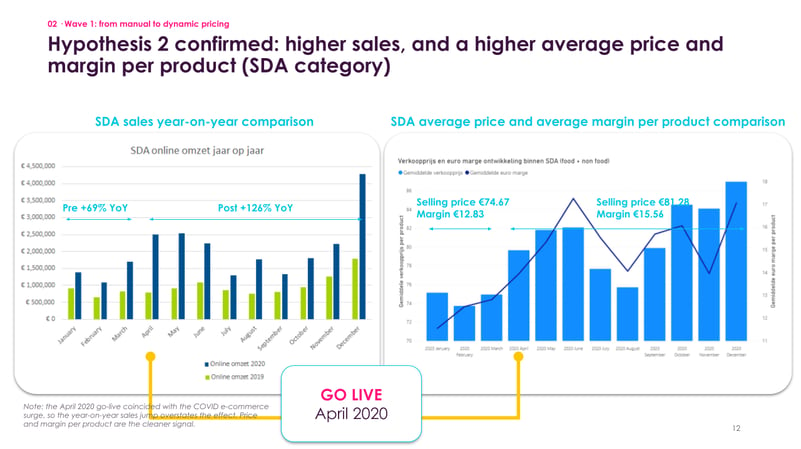
After go-live in April 2020, the average selling price per product rose from €74.67 to €81.28 and the average margin from €12.83 to €15.56.
A jump like that usually smells like heavy discounting. Here, the average selling price and the average margin per product both went up, because the extra volume came from better-priced products across the whole range. The category sold more and earned more per sale at the same time, which Sander called the dream scenario. He also pointed out that in this line of business, results show up on the day the system goes live.
Wave two: automation you can actually see into
Rule-based automation delivered, but it also raised new questions from the people running it. Why is this product priced at €548.93 right now? How is each part of my strategy affecting the outcome? And the most basic one: am I hitting my pricing objectives at all?
Those questions led to a fundamental rebuild of the Omnia platform in 2023, built on three design principles:
- Full flexibility. Any pricing strategy a customer can come up with should be possible, without the software getting in the way.
- Full transparency. Users should always understand what is running. Black-box automation was off the table.
- Intelligent automation. Users should be able to set objectives for the system instead of tweaking granular rules. More on that in wave three.
Borrowing from the strategy consultants
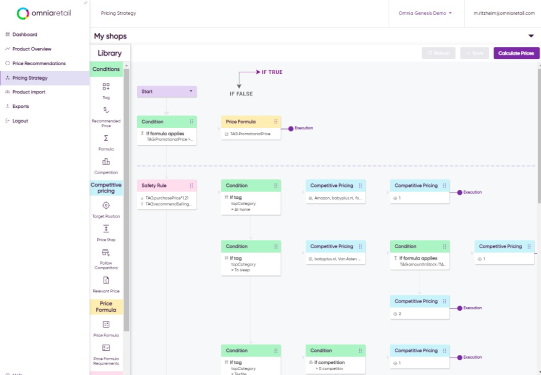
The flexibility piece came from a simple observation. Whenever strategy consultants advised Omnia customers, they drew decision trees. The old software, meanwhile, offered a long laundry list of business rules. So the team made the decision tree the main interface. Users drag and drop branches to build their logic, and once it is running, they can see its full structure, which matters a lot in large companies where many people touch pricing.
Each branch also shows statistics: how many products it covers and whether it is pushing prices up or down. Sander gave an obvious example. If one branch tells the system to always undercut Amazon by 10%, that branch will likely end up setting a large share of your prices and eating into your margin. Real strategies are rarely that blunt, which is exactly why seeing the impact of each piece of logic matters.
The same goes for individual products. A category manager who wants to know where a price suggestion came from can click once and see the exact path through the tree, including the competitor prices used as reference. And since this year, they can also just ask the Omnia Agent, which explains the reasoning in plain language.
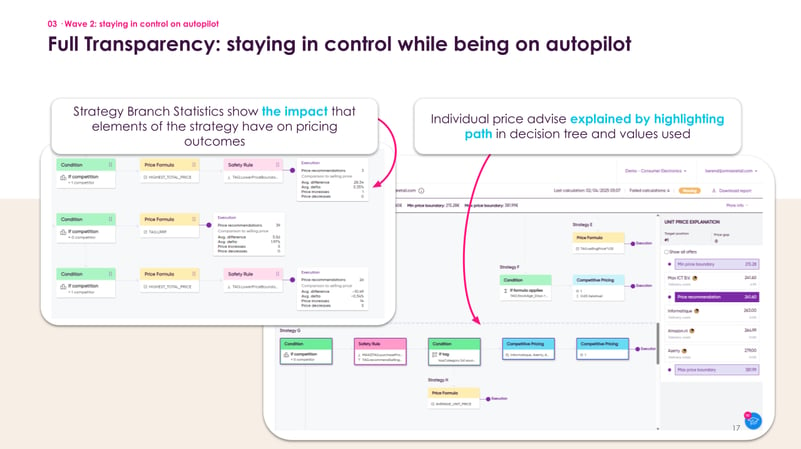
Branch statistics show what each part of a strategy does to prices. The highlighted path explains a single price recommendation.
Wave three: agentic pricing
The third wave is where intelligent automation turns into agentic pricing. Sander described three pillars Omnia is building toward:
- Interaction. Pricing teams spend a lot of time analysing dashboards and building reports. The goal is to replace much of that with a conversation: ask a question, get the full analysis and an explanation of the result.
- Objectives. Instead of setting business rules, users give the system their goals and let it work toward them, within boundaries they define.
- Prediction. Today, most performance analysis happens after a strategy has run. The aim is to show the expected effect of a strategy change before anyone commits to it.
The first pillar is already live. Omnia launched the Omnia Agent in the first half of this year. In its current form, it works like a very knowledgeable pricing analyst: it has access to the data, knows how to analyse it for a given question, and returns a complete answer.
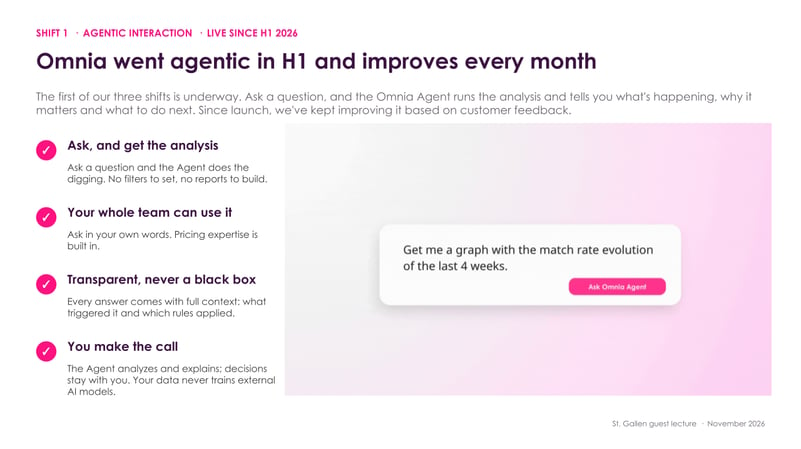 Ask the Omnia Agent a question in your own words, and it runs the analysis for you.
Starting with market price analysis is the safe first step, and that is deliberate. From here, Omnia plans to give the agent more capabilities step by step, eventually including the ability to adjust prices and strategies.
Sander was candid about how much this changed the work of Omnia’s product and development teams. Traditional software comes down to if-then statements, where you tell the program exactly what to do. AI works very differently. It is extremely powerful, but the team had to learn how to rein it in so that it does not hallucinate and customers can fully trust the numbers it gives them.
Scoring the 2025 predictions
In May 2025, Sander gave three longer-term predictions in the same lecture. A year and a half later, he says all three are moving in the right direction, at very different speeds.
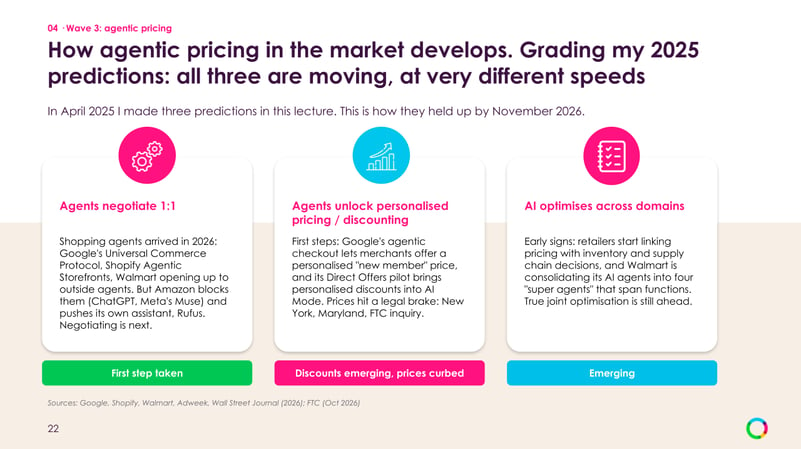 Sander’s 2025 predictions, graded in November 2026.
Prediction 1: agents will negotiate with agents
The idea was that a consumer’s AI agent would eventually negotiate price directly with a retailer’s agent. In a way, that is retail going back to the market stall, where haggling one-on-one was normal before fixed price tags took over.
Verdict: faster than expected. Sander admitted he did not see this coming so quickly. The infrastructure for agents to buy on a shopper’s behalf is already here. Google launched its Universal Commerce Protocol in January 2026, Shopify built agentic storefronts, and Walmart opened its doors to outside agents.
Not everyone is on board. In September, Amazon blocked Meta’s new Muse agent from shopping on its site. Amazon’s official reasons are about security and customer data. Sander pointed to another likely factor: advertising is a huge revenue stream for Amazon, and shopping agents ignore ads completely. Still, he believes consumers will want agents to shop for them, and that pressure will win out. Agents can buy today. Real one-on-one price negotiation between agents is still further off.
Prediction 2: agentic pricing will lead to personalised pricing and discounts
Verdict: slower than expected. The technology is ready. The law mostly isn’t. In most markets, it is illegal to charge different consumers different prices for the same product, even if the technology could do it. Sander was clear that this is one of the reasons Omnia does not do personalised pricing. Omnia does dynamic pricing: every product gets an optimal price that changes as often as needed, and every consumer sees that same price.
What most markets do allow is personalised discounting, as long as the reason is transparent. A young parent who regularly buys nappies can get a targeted Pampers promotion, because the logic is clear. Selling the same Samsung TV for €1,000 to one shopper and €980 to another because the first one owns an Apple device and probably has a higher willingness to pay is not allowed in most places. The US has traditionally been more relaxed, but several US states are now tightening rules on personalised pricing too.
There is some movement on the technical side. At the UCP launch, Google showed how a merchant can offer a “new member” price inside agentic checkout. It is a step short of one-to-one pricing, but it lets retailers offer a lower price to shoppers they don’t know yet, in the hope of winning repeat purchases.
Prediction 3: AI will optimise across domains
The third prediction was that AI would push retailers to stop optimising pricing in isolation and start making trade-offs across pricing, inventory, marketing and other functions.
Verdict: moving gradually. Sander sees more retailers linking pricing and inventory, and some Omnia users already run stock-based pricing. He pointed to Walmart as a telling example. After building a large number of AI agents, the company announced it would consolidate them into four “super agents”, which he reads as a clear step toward AI that works across functions. As AI capabilities grow, he expects cross-domain optimisation to become reality within the next few years.
Where that leaves pricing teams
Sander still stands behind all three predictions. The pace is set less by what AI can do and more by what regulators, platforms and shoppers are ready for, with the legal hurdles around personalised pricing as the clearest brake.
For pricing and category managers, the direction is easy to read. The job moved from setting prices by hand, to managing rules, to steering a system with objectives. The next step is working alongside an agent that analyses, explains, and eventually acts. The teams that get comfortable with that shift early will have more time for the strategic work that no agent is going to do for them.
Before you go, watch our Black Friday pricing from the POV of a Philips Pricing Manager